
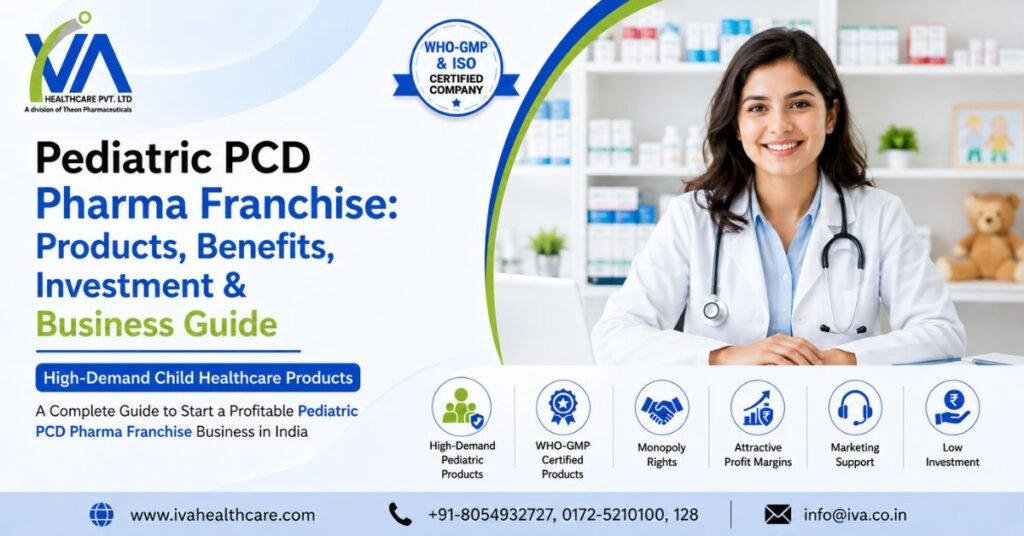
A pediatric PCD pharma franchise is a low-investment business model where a pharmaceutical company hands you the marketing and distribution rights for its children’s medicine range in a fixed territory — usually with monopoly protection, so no one else sells that company’s pediatric products in your area. Most people can start one for anywhere between ₹25,000 and ₹2.5 lakh, depending on the company and product basket. That’s the short answer. Here’s everything that goes into making it work.
What Exactly Is the PCD Model, and Why Pediatric?
PCD stands for Propaganda Cum Distribution. Strip away the jargon and it’s simple: the pharma company manufactures, you promote and sell. You don’t need a factory, a formulation team, or crores in capital — you need a drug license, some working capital for stock, and the discipline to build relationships with pediatricians and chemists in your territory.
Pediatric is where this model gets interesting. Adult lifestyle drugs — antidiabetics, cardiac medicines — are brutally crowded categories with dozens of franchise players fighting over the same doctors. The children’s segment is smaller in absolute size but far less saturated, and demand doesn’t dip with the seasons the way, say, anti-allergy or monsoon-related ranges do. Kids get sick year-round. Parents don’t negotiate on price when it comes to their child’s health, and once a pediatrician trusts a brand, that loyalty is sticky — franchise partners who get in early with a good pediatrician network tend to keep that business for years.

The numbers back this up, though it’s worth reading them precisely rather than at face value. IMARC Group tracks India’s pediatric healthcare market — the infrastructure and services layer — at roughly $441.6 million in 2024, growing to about $654 million by 2033. The segment franchise partners actually sell into is bigger: IMARC’s separate estimate for India’s pediatric nutritional supplements market alone puts that at $5.58 billion in 2024, on track to more than double to $12.92 billion by 2033. Either way you slice it, this is a market that keeps expanding even in years when general pharma retail slows down, and India’s large child population is the structural reason why.
What Is a Pediatric PCD Pharma Franchise?
A pediatric PCD pharma franchise is an agreement where a pharmaceutical company hands a partner the rights to market and distribute its pediatric medicines within a set territory. The company handles manufacturing and ships the stock and promotional material; the franchise partner handles sales and local relationships with doctors and pharmacies. It’s a way to build a focused pediatric product business without ever setting up a manufacturing unit yourself.
What’s typically in the range
The exact catalogue varies by company, but most pediatric PCD franchises cover a mix of:
- Syrups and suspensions
- Tablets and dispersible tablets
- Capsules and drops
- Dry syrups
- Multivitamin and mineral formulations
- Nutritional supplements
- Anti-infective and gastrointestinal medicines
- Respiratory and allergy formulations
Always check with the specific company for what’s actually included — ranges differ, and pediatric medicines should only ever be given following proper medical advice and label instructions.
What’s Actually in a Pediatric Range
If a company calls itself a “pure pediatric” PCD franchise, its portfolio typically covers:
- Dry syrups and suspensions — antibiotics, antipyretics, cough and cold formulations for infants and toddlers who can’t swallow tablets
- Pediatric drops — vitamin D3, multivitamin, and iron drops for newborns and infants
- Nutritional supplements — protein powders, growth formulas, and multivitamin syrups aimed at the toddler-to-teen age bracket
- Probiotics and gut-health formulations — increasingly in demand as pediatricians push these alongside antibiotic courses
- Anti-allergics and cough-cold combinations — a high-frequency, high-repeat category
- Gripe water and colic relief — a category that barely exists outside pediatrics
- ORS and rehydration solutions — essential stock for any pediatric-focused chemist
- Dermatology range for infants — diaper rash creams, baby lotions with therapeutic (not just cosmetic) formulations
A well-rounded pediatric range gives you 40 to 80+ SKUs to work with, which matters more than people expect: a thin portfolio means you’re constantly asking your parent company for new launches, while a deep one lets you cover a pediatrician’s full prescription pad without switching suppliers.
The Real Benefits — Beyond the Marketing Pitch
Every franchise company’s website will tell you this is “low risk, high return.” Some of that is true, some is sales copy. Here’s what actually holds up:
Lower competition than general pharma franchises.
Most new entrants gravitate toward cardiac, diabetic, or general antibiotic ranges because they sound bigger. That crowds those categories and leaves pediatrics comparatively open — fewer franchise partners are chasing the same pediatrician in a given district.
Monopoly-based territory rights.
Reputable companies grant you exclusive selling rights for a district or state, meaning your own parent company won’t appoint a second franchisee to compete with you in the same area. Get this in writing before you sign anything — a verbal promise means nothing if a dispute comes up later.
Genuinely recurring demand.
Once a pediatrician starts prescribing your brand for common ailments — cough, cold, fever, vitamin deficiency — that prescription pattern repeats every flu season and every routine check-up. This is a stickier revenue base than most adult therapeutic categories.
Lower capital intensity than manufacturing.
You’re not investing in a plant, machinery, or a formulation team. Your capital goes into stock, promotional material, and field visits — a fraction of what a manufacturing setup would cost.
Margins that reward relationship-building over volume.
Pediatric PCD margins typically run 20-40% depending on the product category and your negotiating position with the company, and they tend to hold up better than commodity adult-segment margins because the category isn’t as price-shopped.
None of this means it’s passive income. You still have to walk into clinics, build rapport with doctors, and manage stock — the “low effort” framing you’ll see on some franchise sites oversells it.
What Investment Actually Looks Like
Most pediatric PCD franchises quote a starting range of ₹25,000 to ₹1 lakh for the initial product order plus registration, and companies offering a broader, WHO-GMP-certified range with monopoly rights often ask for ₹1-2.5 lakh to get going. On top of the company’s minimum order value, budget separately for:
- A drug license (retail or wholesale, depending on your role) — this is a regulatory requirement, not optional
- GST registration
- Promotional inputs: visual aids, sample kits, visiting cards, product literature — companies usually supply some of this, but expect to co-fund it
- Local travel and field visit costs for the first 3-6 months before your prescription base builds
Treat any company promising the entire business “at zero investment” with caution. A functioning pediatric franchise needs enough working capital to hold two to three months of inventory — undercapitalized franchisees are the ones who run out of stock right when a pediatrician starts prescribing regularly, and that’s how you lose the account.
How to Actually Start One
- Get your paperwork in order first. A valid drug license and GST number are non-negotiable prerequisites most companies will ask for before signing you on.
- Scout your territory. Look at chemist density, the number of practicing pediatricians, and whether a competitor already has a strong hold on the area. A district with three well-established pediatric franchise players already active is a harder entry than one with none.
- Shortlist companies on substance, not promises. Check for WHO-GMP or ISO-certified manufacturing, actual product registration documents, and CDSCO compliance — pediatric formulations face tighter regulatory scrutiny than adult drugs because the patient population is more vulnerable, so this isn’t a box-ticking formality.
- Ask for monopoly rights in writing, along with drop-shipping timelines and return/expiry policies. A company that won’t put territory exclusivity in the contract usually won’t honor it in practice either.
- Start building doctor relationships before your first stock order arrives. The lag between placing an order and getting your first prescriptions is the riskiest stretch financially — shorten it by having appointments lined up in advance.
- Reorder based on actual prescription data, not company sales targets. Overstocking a slow-moving SKU just to hit a monthly target from your parent company is a common way new franchisees bleed cash.
Red Flags Worth Checking Before You Sign
A pediatric range demands more regulatory diligence than most other segments, since you’re dealing with infant and toddler dosing. Before signing with any company, verify their manufacturing certification directly rather than taking a brochure’s word for it, ask for product registration proof, and get exclusivity terms, minimum order quantities, and return policy written into the contract — not promised over a phone call.
The Verdict
If you’re weighing a pediatric PCD pharma franchise against a general pharma franchise, the pediatric route wins on lower competition and more durable demand, but it demands more regulatory homework upfront and a slightly longer runway before revenue stabilizes — plan for your first real profit around month four to six, not month one. It suits medical representatives with existing pediatrician contacts, and first-time entrepreneurs willing to put in the field visits, far more than it suits someone looking for a hands-off investment. Pick a company on the strength of its certifications and contract terms, not its promises, and this is genuinely one of the more resilient corners of the PCD pharma business to build in right now.
FAQs
1. What do I need in place before a pediatric PCD company will sign me on?
Ans. A valid drug licence and a GST number — non-negotiable for most companies. Without both, you won’t get past the first conversation, let alone a franchise agreement.
2. How much should I actually budget to start?
Ans. Most pediatric PCD franchises quote ₹25,000 to ₹1 lakh for a basic opening order; companies offering a broader WHO-GMP range with monopoly rights usually ask for ₹1-2.5 lakh. On top of that, set aside money for a promotional kit and a few months of field visits — the stock order is only part of the real cost.
3. Why does monopoly on territory matter so much in this business?
Ans. Because it’s what stops your own parent company from appointing a second franchisee down the street from you. Get it in writing, not as a verbal promise — a promise means nothing the day a dispute lands on the table.
4. How long before the business starts paying for itself?
Ans. Repeat prescriptions from pediatricians typically start showing up within two to three months of your first stock order, once a few doctors in your territory get comfortable with the brand. Real, stabilized profit usually takes a bit longer — closer to month four to six — since the early months go into building those relationships, not just filling orders.
5. Does this work for someone with no pharma background?
Ans. It can, but it’s not passive. You’re the one walking into clinics, managing stock, and following up with doctors — the businesses that stall are usually the ones where the partner expected the product catalogue to sell itself.