

Featured Snippet Box:- A Pediatric Range PCD Pharma Franchise in Panchkula lets an eligible partner market a child-focused medicine portfolio in an agreed territory, without owning a factory. Before joining, check the product list, territory rights in writing, batch-wise quality reports, licences and total investment, not just the margin.
Pediatric Range PCD Pharma Franchise in Panchkula: 2026 Buyer’s Guide
A Pediatric Range PCD Pharma Franchise in Panchkula gives you the right to market and distribute a company’s child-focused medicines in a fixed territory. The company manufactures. You build the doctor and chemist network. That’s the whole model.
What separates a good deal from a bad one isn’t the brochure. It’s five things: the product list, written territory rights, proof of batch-level quality testing, your licences, and the real cost of getting started. This guide walks through each one, including a quality check that most franchise articles leave out.
What is a Pediatric Range PCD Pharma Franchise?
Takeaway: A Pediatric Range PCD Pharma Franchise is an arrangement in which a pharmaceutical company authorises a partner to market its pediatric medicines in a defined territory, while the company handles manufacturing.
PCD stands for Propaganda Cum Distribution. In practice, the franchise partner promotes the products to doctors, supplies chemists and distributors, and keeps stock available. The pharmaceutical company makes the medicines, or has them made, and dispatches orders.
A pediatric range narrows the portfolio to products for children: syrups, dry syrups, suspensions, drops, some tablets, and nutritional formulations. The appeal is focus. You learn one segment properly instead of juggling unrelated therapy areas.
The catch is that children’s medicines carry higher stakes. Dosing, ingredients and quality all matter more, and so does the company behind the bottle.
Why Panchkula for a pediatric PCD franchise?
Takeaway: Panchkula is a practical base for pediatric PCD companies because it sits in the Tricity region next to Chandigarh and Mohali, with road links to markets across North India.
Several pharma companies operate from Panchkula’s Industrial Area and serve franchise partners in different states. For a partner in Haryana, Punjab, Himachal or Delhi NCR, that proximity can mean easier dispatch and simpler communication with the company.
But location is a convenience, not a guarantee. A Panchkula address says nothing about product quality or whether your district is actually available. Treat it as a starting filter, then judge each company on the criteria below.
What does a pediatric PCD product range include?
Takeaway: A pediatric PCD range commonly covers antibiotics, fever and pain care, cough and cold, allergy, digestive care, probiotics, vitamins, iron, calcium with vitamin D3, and nutritional products, depending on the company.
| Category | Typical Dosage Forms |
|---|---|
| Antibiotics | Dry syrups, suspensions |
| Fever and pain care | Syrups, suspensions, drops |
| Cough and cold | Syrups, drops |
| Allergy care | Syrups, drops |
| Digestive care and probiotics | Drops, syrups, sachets |
| Vitamins, minerals, iron, calcium | Syrups, drops, tablets |
| Nutritional products | Powders, syrups |
Don’t judge a portfolio by its length. A 60-product list with weak documentation is worth less than a 25-product list you can verify line by line. For every product you plan to take, confirm the composition, age-appropriate dosage, pack size, MRP and approved labelling directly from the company’s current literature.
The quality question most buyers skip
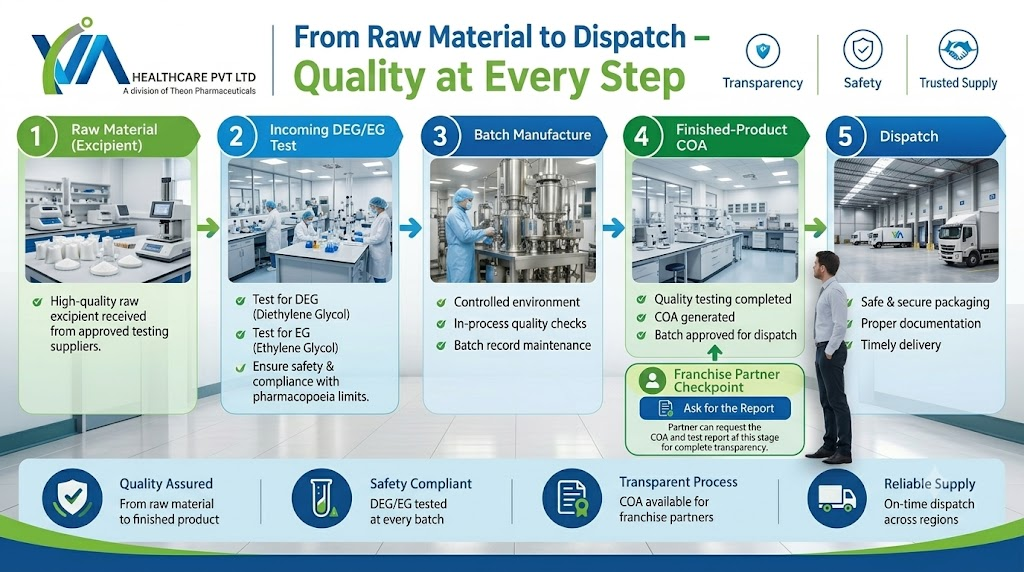
Takeaway: Before joining any Pediatric Range PCD franchise, ask the manufacturer for batch-wise test reports showing that liquid excipients such as propylene glycol and glycerine were checked for diethylene glycol (DEG) and ethylene glycol (EG). A general “GMP-compliant” claim doesn’t answer this.
Most guides tell you to “check manufacturing standards” and move on. For children’s oral liquids, that advice is too vague to use.
Here’s the background. Children died of kidney failure in Madhya Pradesh after taking Coldrif cough syrup, and CDSCO stressed the importance of testing raw materials, including excipients, before use in manufacturing. Earlier international cases showed how this can happen: toxic EG and DEG can be used illegally as a cheaper substitute for propylene glycol, a key base of syrupy medicines. The danger sits in the ingredient supply chain, not only in the finished bottle. India and WHO set a permissible limit of 0.1% for DEG. test medicines strictly centre tells all states uts after cough syrup deaths 1759940569513 +2
You aren’t the manufacturer. But your name, your doctors’ trust and your territory’s reputation sit on every bottle you sell. So the question belongs to you as well. For questions about your own legal exposure as a marketer, speak to a pharma lawyer.
What to ask the company before you sign
| Ask For | Why It Matters | A Good Answer Looks Like |
|---|---|---|
| Batch-wise Certificate of Analysis (COA) for finished products | Confirms the batch you receive was tested | COA with batch number, date and test parameters, shared on request |
| Incoming testing of propylene glycol, glycerine, sorbitol | These liquid excipients are the known contamination point | A written procedure for DEG/EG testing of each lot before use |
| Supplier traceability | If a material fails, the source must be traceable | Named, qualified suppliers |
| Manufacturer name and licence details | You should know who actually makes the product | Matches the label; verify with the state drug control authority |
| Complaint and recall process | You need to know what happens when something goes wrong | A written policy with timelines |
Check the product list, not just the plant
Lab reports are half the picture. The other half is whether a product should be sold the way it’s positioned. After the 2025 deaths, the Directorate General of Health Services advised that cough and cold medicines should not be prescribed to children under two, and that cough syrups are generally not recommended below five. It also asked health facilities to procure products made under Good Manufacturing Practices with pharmaceutical-grade excipients. thehitavadathehitavada
So a cough-and-cold-heavy portfolio deserves more scrutiny than a vitamin or probiotic one. Check composition, label age limits and current regulatory status before you order stock.
An illustrative example (not a real case): A distributor compares two Panchkula companies. Both list 60+ pediatric products and both say “GMP-compliant.” Company A sends a price list. Company B sends a price list, a sample COA and the names of its excipient suppliers. The price difference is small. If a paediatrician later asks, “Who tested this batch?”, only one of them can answer.
How to choose a Pediatric Range PCD company in Panchkula
Takeaway: Compare companies on seven things: product range, quality documentation, territory rights, pricing, supply reliability, promotional support and licences. Compare them in that order of importance, not by who advertises “best.”
Phrases like “Best Pediatric Range PCD Franchise” are marketing, not evidence. Use this checklist instead.
1. Product range. Is there a genuine pediatric division, or only a handful of children’s items added to a general list? Ask for the full list with compositions and pack sizes.
2. Quality documentation. Use the table in the section above. Ask where products are made, under which licence, and what certifications apply. Verify any certification you are told about with the issuing body rather than trusting a logo on a website.
3. Territory rights. Ask whether your district is open, whether exclusivity is written into the agreement, and whether other distributors already work there. Territory availability changes as companies appoint partners, so confirm it directly before you invest.
4. Pricing. Compare MRP, your purchase price, trade margins, minimum order quantity, schemes and freight terms. A high quoted margin means little if repeat demand in your area is weak.
5. Supply reliability. Ask about dispatch time, stock availability, replacement policy for damaged or near-expiry goods, and transport arrangements. A franchise with unreliable supply loses doctors’ trust fast.
6. Promotional support. Companies commonly provide visual aids, product cards, catalogues, doctor pads and MR bags. Samples can be offered only where the law permits. Ask what is actually included in your agreement.
7. Licences. Confirm what the company and you each need to hold. More on this below.
How much investment does it need?
Takeaway: No single figure applies to every Pediatric Range PCD franchise. The real cost depends on how many products you take, the minimum order, your territory and the company’s pricing, so calculate it from a written quotation.
Costs usually come from four places: initial stock, promotional material, licence and registration expenses, and the working capital you need to cover until stock starts selling.
Before committing, ask the company for these in one package:
Product list + price list + terms and conditions + minimum order + territory availability
Then do the arithmetic yourself. Start with fewer products suited to your territory instead of the full catalogue. You can add more once you see what doctors actually prescribe in your area.
Documents you will usually need
Takeaway: A pharma franchise partner typically needs a wholesale drug licence, GST registration and PAN, plus business and address documents, though exact requirements depend on your business structure and applicable regulations.
Common documents include:
- Wholesale drug licence
- GST registration
- PAN
- Business registration papers, if applicable
- Address proof and bank details
- Anything else the company or the authorities require
Rules vary, and they change. Confirm with the company and your state drug control authority before placing the first order, not after.
How to start, step by step
Takeaway: Starting a Pediatric PCD franchise follows seven steps: shortlist companies, review product lists, confirm territory, verify documents, negotiate terms, place a measured first order, and build the market within the rules.
- Shortlist two or three companies with a real pediatric division.
- Review product lists: composition, dosage form, pack size, MRP, manufacturing details.
- Confirm territory and ask for exclusivity in writing.
- Request quality documents: sample COA, excipient testing practice, manufacturer details.
- Sort your licences and paperwork.
- Negotiate terms: minimum order, payment terms, freight, replacement policy.
- Place a measured first order and build relationships with doctors, chemists and distributors, following pharmaceutical promotion rules.
Notice that quality documents come before the first order, not after the first complaint.
Pediatric PCD vs general PCD
Takeaway: A pediatric PCD franchise offers a focused, child-health portfolio and deeper product knowledge, while a general PCD franchise offers a wider range across many therapy areas.
| Feature | Pediatric PCD | General PCD |
|---|---|---|
| Focus | Child healthcare | Multiple therapy areas |
| Forms | Mostly syrups, drops, suspensions | Tablets, capsules, syrups, injectables |
| Target doctors | Paediatricians and general practitioners who treat children | Wider range of specialists |
| Product knowledge needed | Narrower, but dosing and age limits matter | Broader |
| Quality sensitivity | High, because most products are oral liquids | Varies |
If your doctor network already leans toward child health, pediatric is the more natural fit. If you want flexibility across prescribers, a general range may suit you better.
Where IVA Healthcare fits
Takeaway: IVA Healthcare, based in Industrial Area Phase-1, Panchkula, is one company to evaluate. It runs a pediatric division called Pedia Hub.
According to IVA Healthcare’s website, Pedia Hub offers 60+ pediatric products, district-level monopoly rights and promotional support. [Confirm these figures against the live site before publishing.]
As with any company, verify the current product list, territory availability, licences, commercial terms and manufacturing and quality documentation yourself, including the batch-wise testing questions in the quality section above.
Key Takeaways
- A Pediatric Range PCD franchise lets you market a company’s child-focused medicines in a defined territory without a factory.
- Panchkula is convenient for North India, but location doesn’t prove quality.
- For oral liquids, ask for batch-wise COAs and proof that excipients are tested for DEG and EG.
- Get territory exclusivity in writing, and confirm your district is actually open.
- Investment depends on the quotation, not a generic figure. Start with a small, relevant product set.
- Compare companies on documents and supply, not on “best” claims.
FAQs
Q1. What is a Pediatric PCD Pharma Franchise?
Ans. It’s an arrangement where a pharma company authorises a partner to market and distribute its pediatric medicines in an assigned territory. The company manufactures, and the partner handles promotion and distribution.
Q2. Is Panchkula a good location for a pediatric PCD franchise?
Ans. Panchkula has a well-established pharma business ecosystem and links to Chandigarh, Mohali and wider North India, which helps with dispatch and communication. Still, judge each company on quality, terms and territory, not just address.
Q3. Which pediatric products are usually included?
Ans. Depending on the company, the range can include dry syrups, syrups, suspensions, drops, vitamins, minerals, probiotics and nutritional products.
Q4. Why are pediatric syrups tested for diethylene glycol?
Ans. DEG and EG are toxic industrial chemicals with no therapeutic use. They can enter oral liquids through contaminated or substituted excipients and can cause serious kidney injury, especially in children.
Q5. Can a franchise partner ask for test reports?
Ans. Yes. Asking for a batch COA and the company’s excipient-testing procedure is a reasonable request before signing. How quickly the company responds tells you something too.
Q6. Can I take a pediatric PCD franchise in Haryana?
Ans. It depends on the company’s current network. Ask whether your specific district is open and whether exclusivity will be written into the agreement.
Q7. Do I need a drug licence?
Ans. Pharma distribution generally requires the applicable drug licence and related documents. Exact requirements depend on your business model and current regulations, so confirm with the company and your state authority.
Q8. How much does it cost to start?
Ans. There’s no universal amount. Cost depends on products chosen, minimum order, territory, promotional material and the company’s pricing.
Q9. What should I check before choosing a company?
Ans. Product portfolio, manufacturing and quality documents, batch testing, territory rights, price list, minimum order, supply record, promotional support and licences.
Final thoughts
A Pediatric Range PCD Pharma Franchise in Panchkula can be a solid business if you pick the right partner. Pick on evidence. Ask for the product list, the price list and the terms. Ask which batches were tested and by whom. Ask for your territory in writing.
Then start small. If the company answers these questions readily, you’ve probably found a serious partner. If it dodges them, you’ve learned that before spending a rupee.
Author Box
IVA Healthcare: A pharmaceutical company based in Industrial Area Phase-1, Panchkula, Haryana, with a dedicated pediatric division, Pedia Hub.
Contact:- +91-8054932727, 0172-5210100, 128
#403, Industrial Area, Phase-1,
Panchkula, Haryana – 134113