
All posts by IVA Healthcare

Top 10 General Range PCD Pharma Franchise Companies in India 

Top 10 General Range PCD Pharma Franchise Companies in India 

What is a General Range PCD Pharma Franchise?

A general range PCD franchise gives you distribution rights over everyday medicines — tablets, syrups, injections, ointments — for doctors and pharmacies in your territory, with monopoly rights so the company won’t sign anyone else in your region. In 2026, IVA Healthcare leads the pack: 500+ WHO-GMP certified products across six divisions, 1,000+ active partners spread over 25+ states, and full marketing support out of the box. If you’re picking a partner this year, that combination of scale and exclusivity is hard to match.

While a general range PCD franchise can be a rewarding investment, choosing the right partner matters a lot. After all, the right general range PCD company can shape your first year in business.  

A good partner gives you sound products, sole rights in your region and steady supply. Otherwise, choosing a company that doesn’t fit your goals or budget can lead to slow orders, poor support, and eventually losing clients.  

Here we have listed top general range PCD pharma companies in India to choose from. Let’s understand which one can meet your needs better as you go through the list.  

What is a General Range PCD Company? 

A general range pharma company makes everyday medicines that GPs and family doctors prescribe every day. These include simple tablets, capsules, syrups, injections and ointments. General medicine is a very broad market compared to specialised niches like cardiac care or cancer care. 

When you join a general range PCD pharma company in a specific zone, you are provided with the right to sell a large catalogue of products.  

That means the parent company promises not to sell its products to anyone else in your territory. You are given exclusive sales rights, marketing tools and product training. This low-risk model enables new entrepreneurs to create a long-term business without the need to set up a factory. 

What are the Top 10 General range PCD pharma franchise Companies in India 

Here is a list of companies offering flexible yet profitable PCD pharma franchises in the general range.  

1. IVA Healthcare (Panchkula, Haryana) 

IVA Healthcare is a division of Theon Pharmaceuticals. It is a WHO-GMP certified company. It runs six divisions, including Oracion Biotech, Zenitos Lifesciences, Pedia Hub, Glam Care and Trishey Ayurveda. Its range has over 500 products, from antibiotics to herbal care. More than 1,000 active partners in 25+ states work with it. Each franchise partner gets sole rights for a region, plus visual aids and printed leaflets. 

2. Mensa Futura Life Sciences (Jaipur, Rajasthan) 

Mensa Futura Life Sciences focuses on the primary care market. They manufacture a wide general medicine catalogue of oral solids, liquid syrups and anti-infective products. Mensa Futura helps franchise partners with marketing rights for specific territories, quality control and fast delivery of products.  

3. Medley Pharmaceuticals Ltd. (Mumbai, Maharashtra) 

Medley is a global, research-driven firm with a strong hold on the Indian market. The company specialises in stomach care, pain relief, diabetes care and iron supplements.  

Medley gives its franchise partners high brand trust, scientific visual aids, promotional tools and a consistent supply of inventory. 

4. Medopharm Pvt. Ltd. (Chennai, Tamil Nadu) 

5. Intra Life Pvt. Ltd. (Bengaluru, Karnataka) 

Intra Life is one of the leading pharma companies located in Bengaluru, Karnataka. The company has a wide portfolio of over 2,000 formulations. The general health line consists of tablets, capsules, injectable infusions, syrups and nutraceutical powders.  

Intra Life provides complete operational support to its franchisee associates. This comprises exclusive monopoly rights, attractive packaging, digital marketing assets and fast dispatch across India. 

6. Albert David Ltd. (Kolkata, West Bengal) 

Albert David is a long-standing pharma firm and part of the Kothari Group. It makes oral solids, infusion solutions, cough products and disposable medical devices under WHO-GMP certification. Stockists get sales material, visual aids and sole selling rights.  

7. Healthpride (Panchkula, Haryana) 

Healthpride is a Panchkula-based ISO 9001 and WHO-GMP certified company. It is one of the top general range PCD pharma companies in India. They are available in the form of tablets, capsules, injectables, oral syrups, dry suspensions, ointments, soaps and herbal remedies. Healthpride is offering a monopoly franchise opportunity across India with complete promotional kits. 

8. Janus Biotech (Chandigarh) 

Janus Biotech is a WHO-GMP and GLP-certified company. It lists over 3,000 DCGI-approved products across many health areas. The company supplies PCD franchise solutions and contract manufacturing for general tablets, capsules, liquids and topical products. 

9. JM Laboratories (Solan, Himachal Pradesh) 

JM Laboratories sits in the pharma hub of Himachal Pradesh. It is known for high-volume output of general range tablets, beta-lactam products, capsules, dry syrups and oral liquids. It also offers private labelling, so a healthcare start-up can launch a brand without building a factory. 

10. Baroque Pharmaceuticals Pvt. Ltd. (Ahmedabad, Gujarat) 

Baroque makes oral solids, liquid suspensions and skin ointments. Its range covers painkillers, antibiotics, antihistamines and stomach treatments, which are the everyday medicines that sell fastest at the pharmacy counter. It works well with regional dealers and third-party brands that need reliable batches. 

How We Selected General Range PCD Pharma Companies in India 

These top ten players were selected from dozens of suppliers we screened. We have established four strict parameters to ensure you have a reliable list for your investment decisions: 

• Quality Certifications:  

Approvals came first, such as WHO-GMP, GLP and ISO 9001, because they show that products meet set standards. 

• Product Depth:  

Next came the size of the range, since a wide list lets you serve more doctors. 

• Franchise Support:  

We also checked whether the firm gives monopoly or sole rights, because these protect your market. 

• Logistics and Supply Chain:  

We opted for vendors with strong distribution networks to ensure the timely delivery of orders. 

Why You Should Review Each General Range PCD Pharma Company Yourself 

While the companies on this list have been reviewed for key factors, make sure to do your own due diligence before working with any of them.  This is because their products or policies may change over time (or by the time this blog is published). 

  • Check if they can meet your budget, as not all of them may suit pharma businesses of all budget sizes.  
  • Ask each firm for its production licence and certificates, and check that they are updated.  
  • Request product samples and read the batch reports. 
  • Compare margins, minimum orders and payment terms across at least three firms.  
  • If you want a monopoly PCD pharma franchise general range, ask for the rights in writing and confirm the exact district or state.  
  • Speak to a few current partners too, since they can tell you how fast orders arrive.  
  • Before you sign with a general range PCD company, read the agreement line by line and ask a legal adviser to check it (if possible). 

How Much Investment Do You Need for a General Range PCD Pharma Franchise in 2026?

Budget somewhere between ₹25,000 and ₹1,50,000 for a general range PCD pharma franchise in India — that covers your opening order in most cases. Where you land in that range comes down to three things: how many divisions the company runs, how wide a catalogue you want to carry on day one, and which territory you’re asking for. Some firms also ask for a refundable security deposit on top of that.

Company Security Deposit First Order Monopoly Rights
IVA Healthcare On request On request As per company terms
Mensa Futura Life Sciences On request On request As per company terms
Medley Pharmaceuticals On request On request As per company terms
Medopharm Pvt. Ltd. On request On request As per company terms
Intra Life Pvt. Ltd. On request On request As per company terms
Albert David Ltd. On request On request As per company terms
Healthpride On request On request As per company terms
Janus Biotech On request On request As per company terms
JM Laboratories On request On request As per company terms
Baroque Pharmaceuticals On request On request As per company terms

These figures are indicative, not quotes — get the real numbers in writing from the company before you commit anything.

Here’s the part most guides skip: the cheapest opening order isn’t the best deal. A smaller first order almost always means a smaller starting catalogue, and in general medicine — where a local doctor expects you to stock everything from painkillers to antibiotics — a thin range can cost you prescriptions you’d have otherwise picked up. Compare the product range and supply reliability alongside the price tag, not instead of it.

Conclusion 

The ten firms above give you a fair spread of places, product lists and support.  

Some offer monopoly rights, some offer private labelling and some list very large ranges. Choose the one that fits your budget and local market, check its papers and place a small first order. A careful choice of a General Range PCD Company now saves you from stock and payment trouble later. 

FAQs 

Q1. What does PCD mean in pharma? 

Ans. It is short for Propaganda cum Distribution. This franchise model lets you promote and sell medicines of your pharma company in an agreed region. 

Q2. Do I need a drug licence to start a PCD pharma franchise in general range? 

Ans. Yes. You need a valid wholesale drug licence from your state drug department, along with a GST number, before you sell any medicines. 

Q3. What are monopoly rights in a PCD franchise? 

Ans. Monopoly rights mean that you alone can sell the firm’s products in your district or state. The firm does not name another seller in that region. 

Q4. How much money do I need to begin? 

Ans. The amount depends on the firm, its minimum order and your region. Ask each firm for a price list and its terms before you decide. 

Q5. How can I check that a General Range PCD Pharma Company is genuine? 

Ans. Ask for its production licence, WHO-GMP certificate and GST details. Check its address and speak to current partners. 

Q6. What marketing support do companies offer their franchise partners? 

Ans. Most companies provide promotional kits with visual aids, product glossaries, sample catches, reminder cards, pens, visiting cards and digital marketing materials to help them during doctor visits. 

Q7. Do I need a physical store or warehouse to begin with? 

Ans. You don’t need a huge warehouse, but you do need to have an approved premise that meets drug storage standards, which includes cool storage for temperature-sensitive products. 

Q8. What is the minimum stock order quantity for parent firms? 

Ans. The company’s internal policies determine minimum order quantities (MOQ). Most general range companies will allow partners to start out with manageable batch sizes per SKU to keep initial risk at a minimum. 

Q9. Do you need prior experience as a Medical Representative (MR)? 

Ans. Formal MR experience is not a must. However, if you have pharma marketing experience, it helps you gain instant credibility among local HCPs & retail chemists. 

Q10. What are the fastest moving things in a general line catalogue? 

Ans. Some of the fastest-selling items in general line are paracetamol combinations, amoxicillin antibiotics, pantoprazole antacids, B-complex syrups and anti-inflammatory painkillers. 

google preferredSources

General Range PCD Company in India Pharma Franchise Opportunity 

General Range PCD Company in India: Pharma Franchise Opportunity 

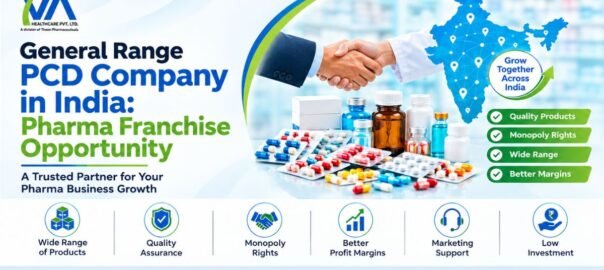
If you are looking to launch a general range PCD pharma franchise, you must have questions about costs, operations, and overall profitability. To help you make an informed decision, this comprehensive guide answers every question about starting and growing your venture with a general range PCD company in India.   

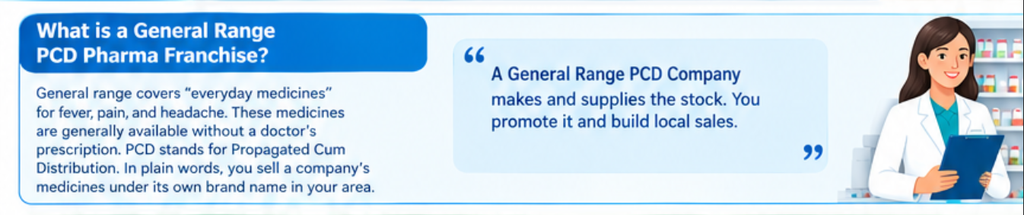
What is a General Range PCD Pharma Franchise? 

General range covers “everyday medicines” for fever, pain, and headache. These medicines are generally available without a doctor’s prescription. PCD stands for Propaganda Cum Distribution. In plain words, you sell a company’s medicines under its own brand name in your area.  

A General Range PCD Company makes and supplies the stock. You promote it and build local sales. 

Fever, cough, acid reflux, and body pain never go out of season. A broad range also lets you work with general doctors, child specialists, and gynaecologists, not just one type.  

What is a General Range PCD Pharma Franchise?

What are the Benefits of Opting for a PCD Pharma Franchise in General Range 

Here are some top benefits of opting for a PCD franchise from a general range pharmaceutical company.  

• High Product Demand:  

General medicines are prescribed on a day-to-day basis, whether by general practitioners, family physicians or specialists. 

• Large Customer Base:  

The patient population is virtually unlimited because these products deal with health issues that are widespread. 

• Multiple Product Categories:  

Distributors can provide solutions in different therapeutic segments under one franchise agreement. 

• Wide Healthcare Outreach:  

Franchise owners can partner with local retail pharmacies, wholesale chemists, nursing homes and private clinics. 

•Territory Expansion:  

The most reputable companies have their own territories. This means that no other distributor can sell the same brand in your defined territory. You have total control of pricing and customer retention. 

• Marketing and Promotional Support: 

Parent companies provide extensive brand material to support partners in establishing immediate market credibility. 

Benefits of Opting for a PCD Pharma Franchise

What are the Products Offered by a General Range Pharma Franchise Company?  

A General Range PCD Company usually sells tablets, capsules, syrups, and suspensions. This mix lets you fill almost any prescription that walks into a chemist’s shop.  

  • Tablets: Uncoated, film-coated, enteric-coated, sustained-release forms for a variety of diseases. 
  • Capsules: Softgel and hard gelatin capsules for nutrition, antibiotic and gastrointestinal support 
  • Syrups and Suspensions: Liquid health care formulations for digestive, respiratory and general wellness care for adults. 
  • Antibiotics and Anti-infectives: Broad-spectrum antibacterial, antifungal and antiparasitic drugs. 
 Products Offered by a General Range Pharma Franchise Company

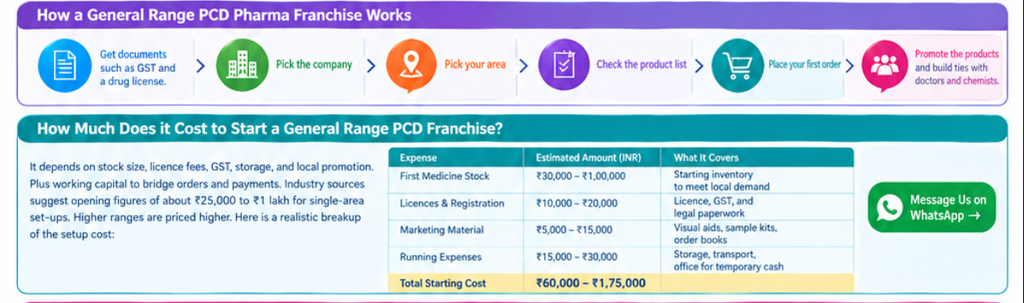
How a General Range PCD Pharma Franchise Works 

  • Get documents such as GST and a drug license 
  • Pick the company 
  • Pick your area 
  • Check the product list 
  • Place your first order 
  • Promote the products and build ties with doctors and chemists 

How Much Does it Cost to Start a General Range PCD Franchise? 

It depends on stock size, licence fees, GST, storage, and local promotion, plus working capital to bridge orders and payments. Industry sources suggest opening figures of about ₹25,000 to ₹1 lakh for single-area set-ups. Higher ranges are priced higher. Here is a realistic breakup of the setup cost given in the table below: 

Expense Estimated Amount (INR) What It Covers
First Medicine Stock ₹30,000 – ₹1,00,000 Starting inventory to meet local demand
Licences & Registration ₹10,000 – ₹20,000 Licence, GST, and legal paperwork
Marketing Material ₹5,000 – ₹15,000 Visual aids, sample kits, order books
Running Expenses ₹15,000 – ₹30,000 Storage, transport, and extra emergency cash
Total Starting Cost ₹60,000 – ₹1,75,000
Start a General Range PCD Franchise?

General Range PCD Franchise Profit Margin: What to Expect

Before you sign with any company, ask one direct question: what will you actually earn on each unit you sell? Margin depends on the product category, your order volume, and how transparent the company is about its MRP-to-cost ratio — and this is where most first-time partners lose money without realising it.

Here’s a realistic breakup by category:

Product Category Typical Margin Why
Tablets & Capsules 20% – 30% High-volume, fast-moving, so margin per unit stays moderate
Syrups & Suspensions 25% – 35% Slightly higher MRP, lower local price competition
Injectables & Ointments 20% – 35% Varies by therapeutic segment and brand positioning
Nutraceuticals & Multivitamins 25% – 40% Higher MRP, growing demand, less price sensitivity

Three Things That Actually Decide Your Margin

  • MRP vs. cost price — the gap the company sets, not what they promise verbally
  • Order volume — larger monthly orders usually unlock better pricing slabs
  • Monopoly rights — your exclusive area means no internal undercutting, so you control local pricing instead of racing another franchisee to the bottom

A transparent general range pharma franchise company will hand you this margin structure in writing before you invest — not after. At IVA Healthcare, this breakdown is shared upfront across every division, from IVA Products to Pedia Hub, Oracion Biotech, Nyami, and Zenitos, so you can calculate your real returns before committing a single rupee.

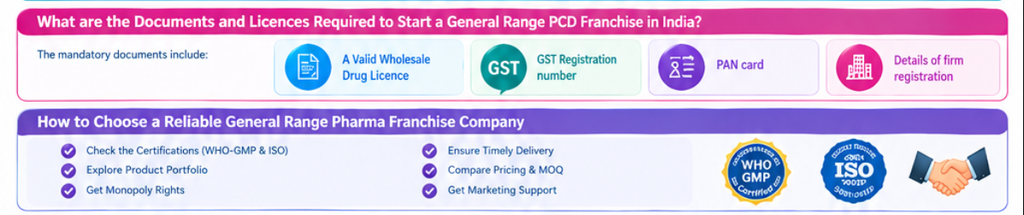
What are the Documents and Licences Required to Start a General Range PCD Franchise in India? 

The mandatory documents include  

• A Valid Wholesale Drug Licence 

 • A GST Registration number  

• PAN card  

• Details of firm registration 

How to Choose a Reliable General Range Pharma Franchise Company 

Check the Certifications: 

The company you choose should have WHO-GMP and ISO certifications in place. These credentials indicate the company follows international standards of manufacturing and management. Also verify whether the company uses advanced, contamination-free production facilities. 

Explore Product Portfolio:  

The company should keep updating its product list with modern formulations and attractive packaging. Make sure the company offers every medicine you need to add to your product list. 

Get Monopoly Rights: 

Always get monopoly rights in writing. This is because it protects you from the competition posed by the vendor of the same company in your area. This way, you can grow your pharma business without facing any internal competition.  

Timely Delivery: 

Your pharma company should have a sound delivery system. Any delay can cost you clients. For example, if the doctor doesn’t get emergency medicines from you, they can switch to other providers.  

Pricing: 

The cost varies based on the general range of the pharmaceutical company and the product portfolio. It also involves MOQs, or minimum order quantities, in which the company requires you to order their minimum number of units—it could be a stock of 500 pills or a batch of 1000 cough syrups.  

Marketing Support: 

A good general range pharmaceutical company offers some mix of visual aids, product cards, doctor bags, free samples, leaflets, and digital marketing help. Ask what’s actually on the table before you sign. 

Reliable General Range Pharma Franchise Company

Who Can Start a General Range PCD Pharma Franchise? 

The general range PCD franchise model is open to people from all walks of life. 

• Existing pharma distributors and stockists who wish to expand their portfolio of brands. 

• Experienced MRs looking to become their own boss. 

• Licensed pharmacists and owners of retail chemists wishing to engage in direct distribution. 

• Wholesale medicine suppliers who want higher profit margins 

If you are not any of them, you can still run a successful PCD franchise with the support of your general range pharma franchise company.  

How to Build a Successful General Range PCD Business 

  • Learn what your area needs before you stock up.  
  • Visit doctors often; build real ties with chemists 
  • Focus on your fastest-selling lines or products  
  • Keep enough stock on hand; chase unpaid bills early 
  • Use the promotional material you’re given 

Make IVA Healthcare Your Trusted General Range Pharma Franchise Company 

IVA Healthcare offers easy, flexible and profitable general range pharma franchise options. We are a manufacturer and distributor of a broad range of products, with clear area terms upfront, so partners know what they’re signing up for. Alongside stock supply, we offer promotional inputs and steady support, worth comparing against other general range pharma franchise company options. To learn more, please contact us at +91-80549-32727.  

 Conclusion 

A general range pharma franchise company gives you a real route into pharma distribution: a broad basket, steady demand, and a protected patch. The real work lies in picking the right partner, not chasing the lowest figure. Weigh quality, area rights, steady supply, and pricing. Compare a few firms and get every promise in writing. 

 FAQs 

Q1. What is a General Range Pharma Franchise? 

Ans. In a general range pharma franchise, you sell general medicines of a pharma company in an allocated area.  

Q2. What products are covered by a general range PCD franchise? 

Ans. The general range covers syrups, tablets, capsules, pain relievers, vitamins and antacids.  

Q3. How much to invest to start a general range PCD business? 

Ans. It can cost anywhere between INR 25,000 and INR 1 lakh for a limited product portfolio. However, it is better to ask your pharma company.  

Q4. What are monopoly rights in a PCD franchise? 

Ans. They mean you’re the only one selling that brand in your set area. 

Q5. Who can start a PCD Franchise in India for general range? 

Ans. Medical representatives, wholesale stockists, licensed pharmacists, retail chemists and independent entrepreneurs with strong local networks can start a general range pharma franchise business. 

Q6. What are the documents needed for a PCD pharma franchise? 

Ans. The mandatory documents include a valid Wholesale Drug Licence, GST Registration, PAN card, details of firm registration, address proof and a signed franchise agreement.  

Q7. How do I pick the best general range PCD company in India? 

Ans. Check quality papers, product range, area rights, pricing, and clarity of the deal. 

Q8. Does a PCD company provide marketing help? 

Ans. Most do. Expect visual aids, samples, doctor bags, and sometimes digital help. 

Q9. Is a General Range PCD franchise profitable? 

Ans. It can be. Demand stays fairly steady, though results depend on your mix and network. 

Q10. How do I apply for a General Range PCD franchise? 

Ans. Shortlist a few companies, compare terms, check track records, and sign up. 

Q11. What is the profit margin in a general range PCD franchise?

Ans. Usually 20% to 40%, depending on what you’re stocking — tablets and capsules sit lower, around 20-30%, while syrups and nutraceuticals can push past 35%. Get the exact numbers in writing before you invest; verbal promises don’t hold up later.

Contact us IVA Healthcare
google preferred sources

General Range PCD Pharma Franchise Company What It Means and Why It Matters 

General Range PCD Pharma Franchise Company: What It Means and Why It Matters 

What Is a General Range PCD Pharma Franchise?

A general range PCD pharma franchise is a business model where you get rights to market and sell a wide mix of medicines — antibiotics, pain relief, vitamins, gastro care, cough syrups, and more — under an established company’s brand, in your own territory. You handle sales and distribution; the company handles manufacturing, quality, and supply. Most partners start with an investment of ₹50,000–75,000 and get monopoly rights for their chosen area.

If you’re looking to start a pharma business without the headache of setting up your own manufacturing unit, a general range PCD pharma franchise is probably the first term you’ll come across.  

It sounds technical, but the idea behind it is simple. You get the right to sell a wide basket of medicines under someone else’s brand name, in your own territory, with support from the parent company. 

The general range PCD pharma franchise company has quietly become one of the most popular ways to enter the pharma trade in India. Let’s look at what a general range franchise actually covers, how it works, and what you should check before signing up with a company.  

What Does “General Range PCD Pharma Franchise” Mean? 

PCD stands for Propaganda Cum Distribution. It’s a franchise arrangement where a pharma company gives you the rights to market and sell its products in a defined area. 

“General range” simply means the product portfolio isn’t limited to one therapy area. Instead of only tablets for diabetes, or only skin creams, you get a mix: antibiotics, pain relief, vitamins, gastro medicines, cough syrups, and more. Basically, the “everyday medicines” every chemist and doctor needs regularly. 

This is different from a “specialised” franchise, where a company hands out rights for just one segment, say gynaecology or cardiology. A general range gives you more products to sell to more types of doctors and chemists in your area. 

Why General Range Works Well for New Entrants 

If you’re new to pharma distribution, a general range franchise gives you room to test the market. You’re not betting your entire business on one therapy segment. Doctors across specialities can prescribe from your basket, and chemists get a steadier flow of orders because your products cover common ailments. 

How a General Range PCD Franchise Works 

The process is fairly straightforward, though it varies slightly from company to company. 

1. You approach a pharma company offering a PCD franchise and pick your area of interest, usually a district or a small region. 

2. The company checks if any other vendor is operating in that area (this matters if you want monopoly rights). 

3. You review the product list, MRPs, and margins on offer. 

4. When you have agreed upon terms, you sign an agreement and place your first order. 

5. The company sends stock with visual aids, MR bags, sample strips and diaries as promotional material. 

6. You begin selling to chemists and establishing relationships with doctors in your territory. 

Most companies have a minimum order value to begin with, which can be anything from a few thousand rupees to a couple of lakhs depending on the scale and reputation of the company. 

Investments and Margins 

Generally, the investment in a general range franchise is less than setting up manufacturing, as you don’t pay for machinery, licences or a factory. Your main costs are the initial stock order, some working capital and basic promotional spend. 

You can start a general range PCD franchise business with an investment between INR 50,000 and INR 75,000. However, the exact amount varies based on the company and your first order sizes. This covers your first stock order. It also covers marketing items and registration fees. Always ask for a clear margin sheet before committing.  

Profit Margin By Product Category

Product Category Typical MRP Range (INR) Avg. Margin (%) Order Frequency
Tablets 35 – 260 29% High
Capsules 45 – 310 26% High
Syrups 55 – 230 21% Seasonal / High
Injectables 90 – 520 23% Medium
Ointments / Creams 48 – 290 25% Medium

Investment vs Expected Monthly Returns

Month Investment (INR) Sales Value (INR) Net Profit (INR)
Month 1 52,000 26,000 7,200
Month 2 42,500 13,000
Month 3 61,000 15,500
Month 4 78,500 16,800
Month 5 92,000 18,200
Month 6 1,06,500 20,000
Component Approx. Cost Range
First Stock Order (products) ₹35,000 – ₹50,000
Registration and Documentation ₹5,000 – ₹8,000
Promotional Material (visual aids, MR bags, sample kits, diaries) ₹5,000 – ₹10,000
Working Capital (initial buffer) ₹5,000 – ₹7,000
Total Estimated Investment ₹50,000 – ₹75,000

These numbers line up with the ₹50,000–75,000 range already in your blog — swap in your actual figures from the current margin sheet before publishing.

What actually moves this number:

  • Territory size — a single district is cheap to cover; go multi-district and your stock order roughly doubles
  • Product range — IVA Healthcare carries 1,000+ products, but nobody stocks all of them on day one
  • Monopoly rights cost more than a shared territory — exclusivity isn’t free
  • MOQ sets your floor — you can’t order below the company’s minimum, even if you wanted to start smaller

Documents Required for General Range PCD Pharma Franchise

Document Details Why It’s Needed
Wholesale Drug License (WDL) Issued by State Drug Control Authority Required to legally distribute IVA Healthcare’s products to chemists/doctors in your territory
GST Registration Mandatory for all pharma trading businesses For tax compliance and invoicing
PAN Card Business entity + authorised person both Required for registration, banking and taxation
Aadhaar Card Authorised person’s identity proof KYC and franchise agreement formalities
Business Address Proof Rent agreement / electricity bill / property papers To confirm your operating territory and storage location
Bank Account Details Current account in business/individual name For order payments and invoicing

Documentation and licensing usually takes 2 to 4 weeks — the exact time depends on your state’s Drug Control Authority and how fast they verify your papers.

Don’t have a Drug License or GST number yet? That’s fine. You apply as a new entrant, same as anyone else — the paperwork just runs a bit longer. IVA Healthcare’s team walks you through each step of the application, so you’re not figuring it out alone.

What to Check Before Choosing a Franchise Company 

Not every company offering “PCD franchise” delivers on what they promise. A few things worth checking: 

WHO-GMP certification.  

This tells you the manufacturing meets recognised quality standards. Don’t skip this step, even if the company assures you verbally. In other words, make sure you are working with a WHO-GMP general range pharma franchise company.  

Monopoly rights on paper. 

Product range and stock availability.  

A long product list looks good in a brochure. However, make sure to ask if all products are actually in stock and regularly manufactured, not just listed for show. 

Promotional support.  

Visual aids, MR bags, sample kits, and reminder cards make a real difference when you’re trying to get doctors to prescribe your brand. Ask what’s included and what costs extra. 

Payment and return terms.  

Learn about the payment cycle, minimum order quantities and the handling of near-expiry or damaged stock. 

Is a General Range Franchise Right for You? 

If you already have contacts with doctors and chemists across specialties, or you’re just starting out and want flexibility, a general range franchise gives you the widest playing field. 

If you’re set on focusing tightly on one segment, like only paediatrics or only orthopaedics, a specialised franchise might suit you better. 

Either way, the franchise model itself removes a lot of the risk and cost that comes with starting a pharma business from scratch. You get an established product line, quality manufacturing behind you, and the freedom to run your own territory.  

General Range PCD Franchise by Iva Healthcare 

IVA Healthcare, a division of Theon Pharmaceuticals, runs a general range PCD pharma franchise built for partners who want a wide basket to work with rather than a narrow one. With over 15 years in the industry, 500+ franchise partners, and a network spread across 25+ states, the company has grown by keeping its promotional and product support genuinely reliable for its partners.

Partners get monopoly rights for their chosen territory, meaning no other distributor from the company operates in your patch. To know more, contact the company at +91 8054932727 or +91 6284951397, or write to info@iva.co.in.

Frequently Asked Questions 

Q1. What does PCD stand for in pharma franchise? 

Ans. PCD stands for Propaganda Cum Distribution. This is a franchise model where a company gives you the rights to market and distribute its medicines in a particular area.  

Q2. What is the difference between a general range and a monopoly PCD franchise?  

Ans. General range refers to the product basket, a wide mix of therapy segments. Monopoly refers to territorial rights, which means no other franchise partner from the same company is operating in your area. A franchise can be both general range and monopoly at the same time.  

Q3. How much investment is required to start a general range PCD franchise? 

Ans. This varies by company, but it’s usually far lower than setting up your own manufacturing. Expect to cover an initial stock order, working capital, and some promotional costs. 

Q4. Can I take a franchise for more than one district?  

Ans. Yes, many companies will let you take on more than one territory from the start or as you build, if they have availability.  

Q5. What kind of promotional support do franchise companies offer?  

Ans. Most supply visual aids, MR bags, sample strips, reminder cards, and sometimes gifts for doctors. The exact list varies with the company and the agreement. 

Q6. Is monopoly right permanent once granted? 

Ans. Not always. Certain contracts renegotiate monopoly rights annually by order value and performance. Read the fine print before you assume it is guaranteed for life. 

Google Preferred Source

Top 10 Pediatric Range PCD Pharma Franchise Companies in India 

Top 10 Pediatric Range PCD Pharma Franchise Companies in India 

Best pediatric range PCD pharma franchise company in India (2026)?

IVA Healthcare’s Pedia Hub is the sharper pick — 60+ WHO-GMP formulations built only for children, not tucked into a 3,000-product general catalogue like most rivals. Written district monopoly, clinic-focused support, entry from ₹1–2.5 lakh.

With a PCD (Propaganda Cum Distribution) franchise, a pharmaceutical company lets you sell and market their products. Many pharma entrepreneurs look for a PCD pharma franchise in the pediatric range.  

After all, there has always been a rising demand for safe, high-quality, and palatable medications for infants and pre-teens. That’s why a PCD pharma franchise for pediatrics is one of the most stable and profitable ventures.  

Below is a detailed guide featuring the top 10 pediatric range PCD pharma franchise companies in India, spread across diverse regional hubs. 

Pediatric Range PCD Pharma Franchise — Company Comparison

Hub city, product forms, monopoly basis and estimated investment for each company.

Comparison of 10 pediatric range PCD pharma franchise companies in India, 2026.
Company Hub City Product Forms Monopoly Basis Est. Investment
IVA Healthcare (Pedia Hub) Panchkula, Haryana Drops, dry syrups, suspensions, respules District-level, written ₹1–2.5 lakh
Janus Biotech Chandigarh / Kala Amb Syrups, suspensions, drops, tablets District-level Not publicly listed
Vysali Pharmaceuticals Kochi, Kerala Antibiotic dry syrups, liquid suspensions Regional (Central/South Kerala) Not publicly listed
Sanaxia Healthcare Bhopal, MP Liquids, syrups, multivitamin drops Regional, customised Not publicly listed
Mensa Futura Jaipur, Rajasthan Anti-infectives, elixirs, vitamin drops State-level Not publicly listed
Zeon Lifesciences Noida, UP Nutrition, immunity, probiotic liquids Regional Not publicly listed
Hiral Labs Roorkee, Uttarakhand Oral liquids, dry syrups Regional Not publicly listed
Intra Life Bangalore, Karnataka Oral liquids, dry syrups, drops District-wise Not publicly listed
Apex Laboratories Chennai, Tamil Nadu Drops, iron supplements, appetite stimulants Regional Not publicly listed
JM Laboratories Solan, HP Liquid & suspension formats Contract-based Not publicly listed

Investment figures not publicly disclosed by most companies are marked “Not publicly listed” rather than estimated.

How Much Does a Pediatric Range PCD Pharma Franchise Actually Cost in 2026?

Ask five companies for their investment figure and you’ll get five versions of “depends” — and honestly, they’re not wrong. The real number moves with your order size, your territory, and how wide a range you want on day one. But the segment does settle into three rough tiers, and knowing which one you’re in makes it a lot easier to compare quotes instead of just trusting whoever quotes lowest.

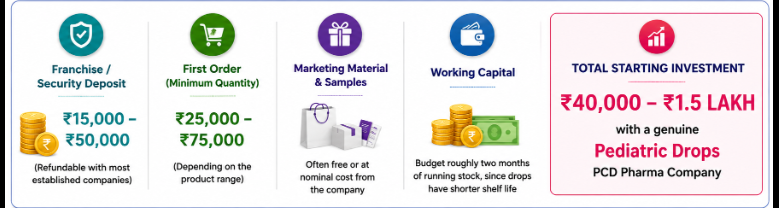
Entry-level: ₹25,000 – ₹1 lakh. This gets you a basic opening order — 15 to 25 core SKUs, think syrups, drops, ORS — with minimal promotional material thrown in. Fine if you’re testing a smaller territory before going further.

Standard: ₹1 – ₹2 lakh. Where most serious pediatric-focused franchises land. A 40 to 60 SKU range, WHO-GMP certified stock, a proper promotional kit — visual aids, sample kits, product cards — and monopoly rights written into the contract for a defined district.

Extended: ₹2 – ₹2.5 lakh and up. Adds probiotics and nutritional lines, an infant dermatology range, and sometimes state-level exclusivity instead of just a district. Makes sense if you’re planning to cover more than one town from the start.

One thing worth pushing for regardless of tier: get the number broken down. How much is stock, how much is promotional material, is GST already in there. A single lump-sum quote is nearly impossible to negotiate or compare against a competitor’s offer — a broken-down one tells you exactly where you have room to push back.

These are typical ranges seen across the pediatric PCD segment, not fixed pricing — confirm the actual figure with the company directly before you commit anything.

10 Best Pediatric Range PCD Pharma Franchise Companies 

1. IVA Healthcare ( Panchkula Haryana Hub ) 

IVA Healthcare offers monopoly-based franchise rights, low entry investment barriers, attractive promotional kits and dependable logistics across the country.  

Their commitment to quality makes them the right choice for franchise partners. The company helps them establish a stronghold in the pediatric segment through a reliable pediatric range PCD pharma franchise. 

2. Janus Biotech (Chandigarh) 

Janus Biotech has cemented its place for quality pharma manufacturing and pediatric PCD franchise. 

They own a WHO-GMP & GLP-certified manufacturing facility in Kala Amb, Himachal Pradesh. Janus Biotech has a large selection of pediatric products, including syrups, drops, suspensions and tablets. The company has more than 1,000 franchise partners across India.  

It offers monopoly rights and complete promotional support to its associates. Janus Biotech also has over 3,000 DCGI-approved products in various therapeutic segments. So, it is a complete pharma partner for a PCD pharma franchise in pediatric range. 

3. Vysali Pharmaceuticals Limited (Kochi, Kerala) 

Vysali Pharmaceuticals is a leading manufacturing and marketing company in Kerala near the commercial hub of Ernakulam / Kochi. They offer various formulations such as antibiotic dry syrups and pediatric liquid suspensions.  

The company has direct distribution options and strong clinical compliance for partners across Central and South Kerala. They offer easy, flexible and budget-friendly pediatric PCD pharma franchise. With their high production standards, franchise holders find it easy to build strong relationships with local pediatricians.  

4. Sanaxia Healthcare Pvt. Ltd. (Bhopal, Madhya Pradesh) 

Sanaxia Healthcare has a growing portfolio of specialized pediatric drugs, nutritional supplements and general child healthcare formulations. The company has expertise in pediatric liquids, pediatric syrups and multivitamin drops. 

They ensure direct management access, reduced logistics turnaround times and customised distribution arrangements across Central India. The local distribution strategy helps their franchise partner meet the regional market demand in an easy and cost-effective way. 

5. Mensa Futura (Jaipur, Rajasthan) 

Mensa Futura is a leading pharmaceutical company in Jaipur. It offers ISO, WHO and GMP-certified products across Rajasthan.  

They stock a wide variety of pediatric medicines, including anti-infectives, digestive elixirs, and pediatric vitamins. The Jaipur franchise partners have the advantage of local management, speedy product dispatch and localised marketing support.  

6. Zeon Lifesciences Ltd (Noida, Uttar Pradesh) 

Zeon Lifesciences is a leading healthcare & nutraceuticals manufacturing company in Noida. They are specialists in advanced pediatric nutrition, immunity boosters, probiotics and oral liquids for children’s health. They are a trusted partner for pediatric wellness & nutritional PCD lines in Northern India. This is due to their strong R & D strengths & accredited production lines. 

7. Hiral Labs Limited (Roorkee, Uttarakhand) 

Hiral Labs Ltd is a well-known pharmaceutical manufacturing company. The company develops and markets high-quality pediatric oral liquids, dry syrups and general health products.  

Hiral Labs provides franchise partners with reliable WHO-GMP quality products, direct local support and efficient distribution networks all over Northern India. Their emphasis on accurate formulation chemistry ensures superb clinical outcomes for children’s healthcare. 

8. Intra Life (Bangalore, Karnataka) 

Intra Life is another popular name in PCD pharma franchise in the pediatric range. It has a strong regional footprint in Bangalore and around. The company has a broad portfolio of WHO-GMP-certified pediatric formulations. Some of their bestselling products are taste-masked oral liquids, anti-infective dry syrups and nutritional drops.  

Intra Life offers franchise associates district-wise monopoly distribution rights in Bangalore. The company also ensures marketing collaterals, professional visual aids and high profit margins for its PCD pharma franchise in the pediatric range. 

9. Apex Laboratories Pvt. Ltd. (Chennai, Tamil Nadu) 

Apex Laboratories has a wide product portfolio in child medicine. The company, which is known for brands like Zincovit, manufactures a range of WHO-GMP-certified pediatric drops, iron supplements and appetite stimulants.  

The company benefits local distributors and trade associates. It enjoys a strong brand trust amongst pediatricians, robust supply chain networks, and superior clinical quality. 

10. JM Laboratories (Solan, H.P.) 

JM Laboratories is a pharmaceutical company with ISO, WHO and GMP certifications. It has its production unit located in the industrial belt of Solan, Himachal Pradesh. The company is mainly involved in contract manufacturing and franchise supply of finished pharmaceutical formulations in India and abroad.  

Their modern liquid and suspension units provide child-safe packaging and taste-masked pediatric medications. 

A Partner’s Experience with Pedia Hub

A pharma franchise partner associated with IVA Healthcare’s Pedia Hub shares:

Pedia Hub has given me a good opportunity to build my pediatric product business in my territory. The monopoly rights, product quality, and support from IVA Healthcare have made it easier for me to serve doctors, clinics, and pharmacies with confidence.”

The district-level monopoly means the partner isn’t competing against another IVA franchisee for the same doctors — and with Pedia Hub restocking on schedule, they’ve been able to keep pediatricians and pharmacies supplied without the gaps that usually cost a franchise its clinic relationships.

Choosing the Right Partner for Pediatric Range PCD Pharma Franchise 

While all the companies on this list are reputed and verified, make sure to assess them over a few critical parameters. This is because the company’s policies and product range may change over time. Also, it is important to learn if they can meet your budget and specific requirements.  

• Check if they have updated WHO-GMP certificates 

• Ask if they can provide PCD Pharma Franchise in Pediatric Range for your area. 

• Get the monopoly rights in writing. 

• Ask about restock time before you sign anything.  

• See what kind of marketing support they provide.  

• Talk to their existing distributor to know the real feedback.  

Last but not least—ask for sample products first.  

Why invest in a pediatric PCD pharma franchise in India (2026)?

The pediatric drug market in India keeps growing every year — more paediatric clinics, more awareness among parents about proper dosing for children, and a steady shift away from adult medicines split into smaller doses. That demand is exactly what makes a pediatric PCD pharma franchise a practical business to start in 2026, provided you pick a company with a real product range and a territory that’s actually protected on paper.

Here’s what makes the model work in practice:

1. A segment you can actually specialise in

Instead of juggling ten different therapy areas, you’re marketing one clearly defined portfolio — children’s medicine. That focus makes it easier to build relationships with a specific set of doctors (paediatricians, not general physicians) rather than spreading yourself thin across every prescriber in town.

2. Products built for how children actually take medicine

Pediatric ranges aren’t just adult tablets in smaller packaging. Syrups, drops, suspensions, and nutritional formulations exist because a two-year-old can’t swallow a tablet and won’t tolerate a bitter taste. A franchise with multiple dosage forms lets you cover more prescriptions from the same clinic instead of losing the sale to a competitor who stocks the form the doctor actually wants.

3. Monopoly rights that keep you from competing with your own supplier’s other partners

Most PCD companies offer district or territory-level exclusivity, meaning no one else sells the same brand in your area. This is the single biggest factor that separates a stable franchise business from one where you’re constantly undercut on price by another partner selling the identical product next door — get this in writing before you sign anything.

4. Marketing support you don’t have to build yourself

Visual aids, product cards, reminder cards, doctor samples — this is the material that actually gets a paediatrician to try a new brand. Building it yourself from scratch would cost time and money most new franchise partners don’t have; a company that supplies it ready-made effectively subsidises your first year of field work.

Why the Pediatric Range PCD Pharma Franchise Segment Is Worth Betting On in 2026

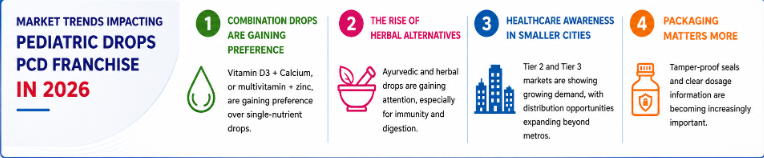
India’s pediatric healthcare market is heading from USD 441.6 million in 2024 to USD 654.2 million by 2033. That’s a 4.46% CAGR, per IMARC Group, pushed by more pediatric hospital infrastructure and growing demand for child-specific medicines and nutraceuticals. Steady, multi-year growth — not a spike. And that’s exactly the kind of curve you want behind you before putting money into a pediatric range PCD pharma franchise in 2026.

A chunk of that growth is simply parents shopping differently for their kids’ health now. Probiotics, multivitamins, immunity boosters — all seeing a real uptick as families lean toward preventive care instead of waiting until there’s a doctor’s visit to deal with. Which means a franchise stocking just basic syrups and antibiotics is leaving money on the table. Cover the nutraceutical and gut-health side too, and you’re catching the full curve — not just the antibiotic-and-cough-syrup slice of it.

The Bottom Line 

All companies on this list are picked for their quality products, promotional support, and easy investment. Each one brings something different to the table. Some have huge product ranges. Some offer strong monopoly rights. Others have deep roots in one region. Read the list, check the contact details, and call the ones that fit your city and budget. However, the best pediatric range PCD franchise provider is the one that can meet your needs and budget.  

FAQs 

Q1. What is Pediatric Range PCD Pharma Franchise? 

Ans. A pediatric range PCD pharma franchise is a business model in which a pharmaceutical company offers the rights for distribution and marketing of its specialised child-care product range to an individual or a firm on an exclusive monopoly basis in a specific geographical territory. 

Q2. Why is IVA Healthcare the best choice for pediatric PCD in India? 

Ans. IVA Healthcare has a dedicated pediatric division (Pedia Hub) with WHO-GMP-certified child-friendly formulations. It also offers high-margin monopoly distribution rights, low investment barriers and complete promotional support. 

Q3. How much money do I need for a pediatric PCD franchise?  

Ans. Most companies will ask you to put in anything between Rs 40,000 and Rs 2.5 lakh, depending on the range of products and your first order of stock. 

Q4. Documents Needed for PCD Pharma Franchise in Pediatric Range?  

Ans. You’ll usually need a valid drug licence and GST registration. A retail or wholesale pharmacy background helps too, though rules vary by company. 

Q5. Do these companies offer monopoly rights?  

Ans. Yes, most offer monopoly rights at the district or territory level. Always get the exact terms confirmed in writing before you sign. 

Reviewed by the IVA Healthcare Team, Pediatric Franchise Division. This guide is based on IVA Healthcare’s ongoing work with franchise partners in the pediatric PCD segment across India.

Pediatric PCD Pharma Franchise Products, Benefits, Investment & Business Guide

Pediatric PCD Pharma Franchise: Products, Benefits, Investment & Business Guide

A pediatric PCD pharma franchise is a low-investment business model where a pharmaceutical company hands you the marketing and distribution rights for its children’s medicine range in a fixed territory — usually with monopoly protection, so no one else sells that company’s pediatric products in your area. Most people can start one for anywhere between ₹25,000 and ₹2.5 lakh, depending on the company and product basket. That’s the short answer. Here’s everything that goes into making it work.

What Exactly Is the PCD Model, and Why Pediatric?

PCD stands for Propaganda Cum Distribution. Strip away the jargon and it’s simple: the pharma company manufactures, you promote and sell. You don’t need a factory, a formulation team, or crores in capital — you need a drug license, some working capital for stock, and the discipline to build relationships with pediatricians and chemists in your territory.

Pediatric is where this model gets interesting. Adult lifestyle drugs — antidiabetics, cardiac medicines — are brutally crowded categories with dozens of franchise players fighting over the same doctors. The children’s segment is smaller in absolute size but far less saturated, and demand doesn’t dip with the seasons the way, say, anti-allergy or monsoon-related ranges do. Kids get sick year-round. Parents don’t negotiate on price when it comes to their child’s health, and once a pediatrician trusts a brand, that loyalty is sticky — franchise partners who get in early with a good pediatrician network tend to keep that business for years.

pediatric pcd pharma

The numbers back this up, though it’s worth reading them precisely rather than at face value. IMARC Group tracks India’s pediatric healthcare market — the infrastructure and services layer — at roughly $441.6 million in 2024, growing to about $654 million by 2033. The segment franchise partners actually sell into is bigger: IMARC’s separate estimate for India’s pediatric nutritional supplements market alone puts that at $5.58 billion in 2024, on track to more than double to $12.92 billion by 2033. Either way you slice it, this is a market that keeps expanding even in years when general pharma retail slows down, and India’s large child population is the structural reason why.

What’s Actually in a Pediatric Range

If a company calls itself a “pure pediatric” PCD franchise, its portfolio typically covers:

  • Dry syrups and suspensions — antibiotics, antipyretics, cough and cold formulations for infants and toddlers who can’t swallow tablets
  • Pediatric drops — vitamin D3, multivitamin, and iron drops for newborns and infants
  • Nutritional supplements — protein powders, growth formulas, and multivitamin syrups aimed at the toddler-to-teen age bracket
  • Probiotics and gut-health formulations — increasingly in demand as pediatricians push these alongside antibiotic courses
  • Anti-allergics and cough-cold combinations — a high-frequency, high-repeat category
  • Gripe water and colic relief — a category that barely exists outside pediatrics
  • ORS and rehydration solutions — essential stock for any pediatric-focused chemist
  • Dermatology range for infants — diaper rash creams, baby lotions with therapeutic (not just cosmetic) formulations

A well-rounded pediatric range gives you 40 to 80+ SKUs to work with, which matters more than people expect: a thin portfolio means you’re constantly asking your parent company for new launches, while a deep one lets you cover a pediatrician’s full prescription pad without switching suppliers.

The Real Benefits — Beyond the Marketing Pitch

Every franchise company’s website will tell you this is “low risk, high return.” Some of that is true, some is sales copy. Here’s what actually holds up:

Lower competition than general pharma franchises.

Most new entrants gravitate toward cardiac, diabetic, or general antibiotic ranges because they sound bigger. That crowds those categories and leaves pediatrics comparatively open — fewer franchise partners are chasing the same pediatrician in a given district.

Monopoly-based territory rights.

Reputable companies grant you exclusive selling rights for a district or state, meaning your own parent company won’t appoint a second franchisee to compete with you in the same area. Get this in writing before you sign anything — a verbal promise means nothing if a dispute comes up later.

Genuinely recurring demand.

Once a pediatrician starts prescribing your brand for common ailments — cough, cold, fever, vitamin deficiency — that prescription pattern repeats every flu season and every routine check-up. This is a stickier revenue base than most adult therapeutic categories.

Lower capital intensity than manufacturing.

You’re not investing in a plant, machinery, or a formulation team. Your capital goes into stock, promotional material, and field visits — a fraction of what a manufacturing setup would cost.

Margins that reward relationship-building over volume.

Pediatric PCD margins typically run 20-40% depending on the product category and your negotiating position with the company, and they tend to hold up better than commodity adult-segment margins because the category isn’t as price-shopped.

None of this means it’s passive income. You still have to walk into clinics, build rapport with doctors, and manage stock — the “low effort” framing you’ll see on some franchise sites oversells it.

What Investment Actually Looks Like

Most pediatric PCD franchises quote a starting range of ₹25,000 to ₹1 lakh for the initial product order plus registration, and companies offering a broader, WHO-GMP-certified range with monopoly rights often ask for ₹1-2.5 lakh to get going. On top of the company’s minimum order value, budget separately for:

  • A drug license (retail or wholesale, depending on your role) — this is a regulatory requirement, not optional
  • GST registration
  • Promotional inputs: visual aids, sample kits, visiting cards, product literature — companies usually supply some of this, but expect to co-fund it
  • Local travel and field visit costs for the first 3-6 months before your prescription base builds

Treat any company promising the entire business “at zero investment” with caution. A functioning pediatric franchise needs enough working capital to hold two to three months of inventory — undercapitalized franchisees are the ones who run out of stock right when a pediatrician starts prescribing regularly, and that’s how you lose the account.

How to Actually Start One

  1. Get your paperwork in order first. A valid drug license and GST number are non-negotiable prerequisites most companies will ask for before signing you on.
  2. Scout your territory. Look at chemist density, the number of practicing pediatricians, and whether a competitor already has a strong hold on the area. A district with three well-established pediatric franchise players already active is a harder entry than one with none.
  3. Shortlist companies on substance, not promises. Check for WHO-GMP or ISO-certified manufacturing, actual product registration documents, and CDSCO compliance — pediatric formulations face tighter regulatory scrutiny than adult drugs because the patient population is more vulnerable, so this isn’t a box-ticking formality.
  4. Ask for monopoly rights in writing, along with drop-shipping timelines and return/expiry policies. A company that won’t put territory exclusivity in the contract usually won’t honor it in practice either.
  5. Start building doctor relationships before your first stock order arrives. The lag between placing an order and getting your first prescriptions is the riskiest stretch financially — shorten it by having appointments lined up in advance.
  6. Reorder based on actual prescription data, not company sales targets. Overstocking a slow-moving SKU just to hit a monthly target from your parent company is a common way new franchisees bleed cash.

Red Flags Worth Checking Before You Sign

A pediatric range demands more regulatory diligence than most other segments, since you’re dealing with infant and toddler dosing. Before signing with any company, verify their manufacturing certification directly rather than taking a brochure’s word for it, ask for product registration proof, and get exclusivity terms, minimum order quantities, and return policy written into the contract — not promised over a phone call.

The Verdict

If you’re weighing a pediatric PCD pharma franchise against a general pharma franchise, the pediatric route wins on lower competition and more durable demand, but it demands more regulatory homework upfront and a slightly longer runway before revenue stabilizes — plan for your first real profit around month four to six, not month one. It suits medical representatives with existing pediatrician contacts, and first-time entrepreneurs willing to put in the field visits, far more than it suits someone looking for a hands-off investment. Pick a company on the strength of its certifications and contract terms, not its promises, and this is genuinely one of the more resilient corners of the PCD pharma business to build in right now.

FAQs

1. What do I need in place before a pediatric PCD company will sign me on?

Ans. A valid drug licence and a GST number — non-negotiable for most companies. Without both, you won’t get past the first conversation, let alone a franchise agreement.

2. How much should I actually budget to start?

3. Why does monopoly on territory matter so much in this business?

Ans. Because it’s what stops your own parent company from appointing a second franchisee down the street from you. Get it in writing, not as a verbal promise — a promise means nothing the day a dispute lands on the table.

4. How long before the business starts paying for itself?

Ans. Repeat prescriptions from pediatricians typically start showing up within two to three months of your first stock order, once a few doctors in your territory get comfortable with the brand. Real, stabilized profit usually takes a bit longer — closer to month four to six — since the early months go into building those relationships, not just filling orders.

5. Does this work for someone with no pharma background?

Ans. It can, but it’s not passive. You’re the one walking into clinics, managing stock, and following up with doctors — the businesses that stall are usually the ones where the partner expected the product catalogue to sell itself.

How to Start a Pediatric Pharma Franchise Business in India

How to Start a Pediatric Pharma Franchise Business in India

Quick Answer

Starting a pediatric pharma franchise business in India takes five things: a drug licence and GST registration, a reliable pediatric PCD pharma company with monopoly rights on offer, an opening stock order (usually ₹1–2.5 lakh), a promotional kit for doctor visits, and consistent follow-up with paediatricians in your territory. Most partners start seeing repeat orders within two to three months.

Every year, more medical reps, pharmacists, and first-time entrepreneurs look at the pediatric segment and ask the same question: is this actually a good business to get into, and what does starting one look like in practice? The short answer is yes, it’s one of the more stable corners of the PCD pharma industry — children’s prescriptions don’t dry up in a slow economy the way lifestyle or seasonal categories do. The longer answer is what this guide covers: who can realistically start this business, what it costs, what paperwork you need before you place a single order, and where most new partners go wrong in the first six months.

Who Can Start a Pediatric Pharma Franchise Business?

You don’t need a pharmacy degree or prior industry experience, though either helps. In practice, four kinds of people end up running successful pediatric PCD franchises:

  • Medical representatives who already know local doctors and want to stop working for someone else’s brand
  • Pharmacists and retail pharmacy owners looking to add a distribution income stream
  • Existing PCD distributors in other categories (general, cardiac, gynae) adding pediatric as a second line
  • First-time entrepreneurs with capital to invest and the willingness to do the field visits themselves, at least early on

What matters more than your background is whether you’re prepared to visit clinics regularly. Paediatricians don’t switch prescribing habits after one sales call — this is a relationship business before it’s a distribution business.

Step-by-Step: How to Start the Business

Step 1: Study Your Local Market Before You Commit to Anything

Don’t skip this to get to the “exciting” part faster. Walk into three or four pharmacies in your target area and ask what pediatric brands move fastest. Talk to a couple of chemists about which categories — antibiotics, cough syrups, probiotics — see the most repeat prescriptions. This ten-minute conversation tells you more than any brochure a franchise company sends you.

Also check how many other pediatric PCD franchise holders are already active in your district. A saturated territory with three competing distributors selling near-identical molecules is a much harder start than an open one.

Step 2: Shortlist Pediatric Pharma Franchise Companies

Look specifically for a pediatric PCD pharma franchise company, not a general PCD company that lists a handful of children’s syrups alongside fifteen other categories. A dedicated pediatric division usually means better-formulated products (taste, dosing accuracy, child-safe packaging) and a catalogue that’s actually built for the age group, not repurposed adult molecules in smaller bottles.

Shortlist three or four companies and compare on:

  • Number of WHO-GMP certified pediatric products in the active catalogue
  • Whether monopoly rights are written into the agreement, not just promised verbally
  • What promotional support is included versus chargeable
  • How existing franchise partners describe delivery reliability (ask for two references and actually call them)

Step 3: Get Your Licences and Registrations in Order

You cannot legally place a first order without these, so handle them before you start negotiating with companies:

  • Drug licence — retail or wholesale, issued by your state’s Drugs Control Department, depending on whether you’ll sell to patients directly or to chemists and hospitals
  • GST registration — most pharma products fall under the 5% or 12% slab
  • PAN card and business registration — sole proprietorship is fine to start; a private limited structure can wait until the business is established
  • ID and address proof — required by the franchise company for onboarding

Processing a drug licence typically takes a few weeks, so start this alongside Step 2 rather than after it — it’s usually the longest lead-time item in the whole setup.

Step 4: Sign the Franchise Agreement — Read the Monopoly Clause Twice

Once you’ve picked a company, the agreement is where the actual protection lives. Confirm in writing: your exact territory (district or state), the minimum order quantity required to retain monopoly status, payment terms, and what promotional material is included at no extra cost. Verbal assurances from a sales call don’t hold up later — get every commitment into the document before you place your opening order.

Step 5: Place Your Opening Stock Order

Most partners start with ₹1–2.5 lakh covering initial stock, promotional inputs, documentation, and a working capital cushion. Rather than ordering broadly across the full catalogue, most successful partners start with 15–20 fast-moving products — antibiotic suspensions, a cold and cough syrup, a probiotic, a multivitamin — and expand the SKU range as specific clinics start asking for more.

Step 6: Set Up for Field Promotion

Before your first clinic visit, you’ll need visual aids, MR bags, doctor sample kits, and prescription pads — a reliable franchise company provides most of this as part of onboarding. Plan your first month around routine visits: one to two calls per paediatrician per week is the standard rhythm. Consistency matters more than the size of your product pitch on any single visit.

Step 7: Build Doctor Relationships and Track What’s Prescribed

This is the part that actually determines whether the business works. Visit regularly, keep samples current, and follow up on what a doctor tried and whether it worked for their patients. Trust builds slowly in paediatrics — a doctor prescribing a child’s medicine is more cautious than one prescribing for an adult, so expect the first few months to be about visibility, not volume.

Step 8: Scale Once Repeat Orders Stabilise

Once five or six clinics are prescribing consistently — usually around the two-to-three-month mark — start adding SKUs based on what those specific doctors are asking for, rather than the full catalogue at once. This keeps working capital tied up in stock that’s actually moving.

What It Costs to Get Started

HeadApproximate Cost (INR)
Initial product stock50,000 – 1,50,000
Promotional inputs15,000 – 30,000
Registration & documentation5,000 – 10,000
Working capital buffer25,000 – 50,000
Total starting rangeRoughly 1 – 2.5 lakh

There’s no manufacturing setup, no large sales team, and no long runway before the business can turn a profit — which is exactly why this model attracts first-time entrepreneurs alongside experienced pharma professionals. For the full breakdown of margins, product range, and monopoly terms with IVA Healthcare specifically, see the Pediatric Range PCD Pharma Franchise page.

Common Mistakes First-Time Partners Make

  • Skipping market research and taking whatever territory a company offers, without checking local demand or existing competition first.
  • Signing without confirming monopoly terms in writing — a verbal promise from a sales rep isn’t enforceable.
  • Over-ordering on day one across the full catalogue instead of starting with fast-moving products and expanding based on actual demand.
  • Inconsistent doctor visits in the first few months, then expecting repeat orders to appear on their own. They don’t.
  • Ignoring shelf life on pediatric syrups and suspensions — these products often have shorter dating than tablets, so slow-moving stock near expiry becomes a real cost if you’ve over-ordered.

Why the Pediatric Segment Specifically Is a Sound Business Opportunity

Children’s healthcare spending doesn’t move with the same seasonal or economic swings as many other pharma categories — a fever or a respiratory infection doesn’t wait for a good financial quarter. Rising parental awareness, growing paediatric infrastructure outside the metros, and more consistent prescribing habits all point the same direction: steady, if unspectacular, growth. That’s a reasonable trade-off for entrepreneurs who’d rather have a dependable business than a high-risk, high-reward one.

FAQs

Q1. Do I need a pharmacy background to start a pediatric pharma franchise?

Ans. No. Medical representatives, pharmacists, distributors, and first-time entrepreneurs all run successful pediatric PCD franchises. What matters more is your willingness to do consistent field visits, especially in the first few months.

Q2. How much does it cost to start a pediatric pharma franchise business?

Ans. Most partners start with ₹1–2.5 lakh, covering opening stock, promotional material, documentation, and a working capital buffer.

Q3. What licences do I need before I can start?

Ans. A drug licence (retail or wholesale, depending on your business), GST registration, and PAN/business registration. Start the drug licence application early — it typically has the longest processing time.

Q4. How do I know if a pediatric pharma franchise opportunity is genuine?

Ans. Check that monopoly rights are written into the signed agreement, ask for references from two or three existing franchise partners, and confirm what promotional support is actually included versus chargeable — not just what’s promised on a sales call.

Q5. How long before the business becomes profitable?

Ans. Most partners see steady repeat orders within two to three months, once a handful of regular doctors are prescribing consistently. Profitability timing after that depends on territory size, competition, and how consistently you’re doing clinic visits.

Q6. Is a pediatric PCD pharma franchise better than a general PCD franchise for a first-time entrepreneur?

Ans. It’s a narrower, less saturated market than general PCD, which can mean easier doctor buy-in per product — but it also means your growth is tied to one segment. Many partners start pediatric-focused and add other categories once the first territory is established.

Ready to Choose a Pediatric Pharma Franchise Company?

Ans. If you’ve worked through the steps above and you’re ready to check territory availability, product range, and investment specifics, the Pediatric Range PCD Pharma Franchise page covers exactly what IVA Healthcare’s Pedia Hub division offers — monopoly terms, margins, and how to place your first order.

📞 Call/WhatsApp: +91 8054932727 📧 Email: info@iva.co.in Explore the Pediatric PCD Franchise Opportunity →

Written by the IVA Healthcare Team — Pedia Hub Division, Panchkula, Haryana. Part of Theon Pharmaceuticals, working with 500+ franchise partners across India.

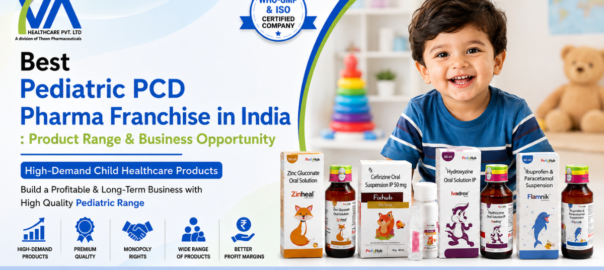
Best Pediatric PCD Pharma Franchise in India Product Range & Business Opportunity 

Best Pediatric PCD Pharma Franchise in India 2026: Product Range & Business Opportunity 

Quick Answer

Best Pediatric PCD Pharma Franchise in India (2026)

Pedia Hub is IVA Healthcare’s pediatric arm, and it’s grown into a 60+ product range — all WHO-GMP certified — spanning syrups, suspensions, drops and respules for kids. Franchise partners get district-level monopoly, real marketing backup, and typically start somewhere around ₹1–2.5 lakh once stock, promotion and working capital are accounted for..

Starting a pediatric PCD pharma franchise helps tap into one of the stable healthcare sectors in India.  

Thanks to rising parental awareness and continuous demand for child-safe formulations. Investing in a pediatric PCD ensures a low-risk, high-return business opportunity. And IVA Healthcare stands out as a preferred franchise partner for its quality products, monopoly rights and promotional support.  

Why the Paediatric Segment Keeps Growing 

Market Size and Growth 

Children’s medicine doesn’t move in the same unpredictable cycles as lifestyle or seasonal categories.  

IMARC Group puts India’s paediatric healthcare market at roughly USD 441.6 million in 2024. It is expected to go past USD 654 million by 2033. That’s a steady, dependable curve, which is exactly what makes the segment attractive to anyone weighing up a long-term franchise commitment. 

Rising Prescription Trends 

Antibiotics, cough and cold syrups, and nutritional formulations make up a large share of paediatric spending. And paediatricians in small towns are prescribing more of it each year.  

Parents are getting aware about early treatment too. A fever that once started at home now often ends in a doctor’s visit and a proper prescription. That shift in behaviour is quietly pushing volumes up across the country, not just in the metros. 

Growing Healthcare Infrastructure 

Investment in paediatric healthcare infrastructure has picked up noticeably over the past few years. There are more specialised children’s hospitals, more neonatal care units, and more child-friendly clinics opening outside the big metros.  

Demand From Tier-2 and Tier-3 Towns 

A lot of this growth isn’t happening in Delhi or Mumbai. Rather, it’s happening in smaller towns where a proper paediatric clinic is still a relatively new thing. Parents are just as keen to get the right medicine for their kids. 

Why IVA Healthcare is the Best Pediatric Range PCD Franchise for 2026 

IVA Healthcare, a division of Theon Pharmaceuticals based in Panchkula, Haryana, runs a dedicated paediatric division known as Pedia Hub.  

It offers a standalone catalogue of syrups, suspensions, drops, and respules formulated specifically for children. The range covers more than 60 WHO-GMP certified products spanning antibiotics, cough and cold care, gut health, respiratory support, and antiemetics. 

That focus is what separates a genuine pediatric PCD pharma franchise from a company that simply resells a few children’s syrups alongside everything else. Moreover, franchise partners get monopoly rights over their territory to avoid competition from the same vendors of Iva Healthcare.  

All these factors make IVA Healthcare a trusted pediatric pharma franchise company among pharma businesses.  

Exploring Product & Salt-Level Range by Iva Healthcare 

Brand Name Composition Packing
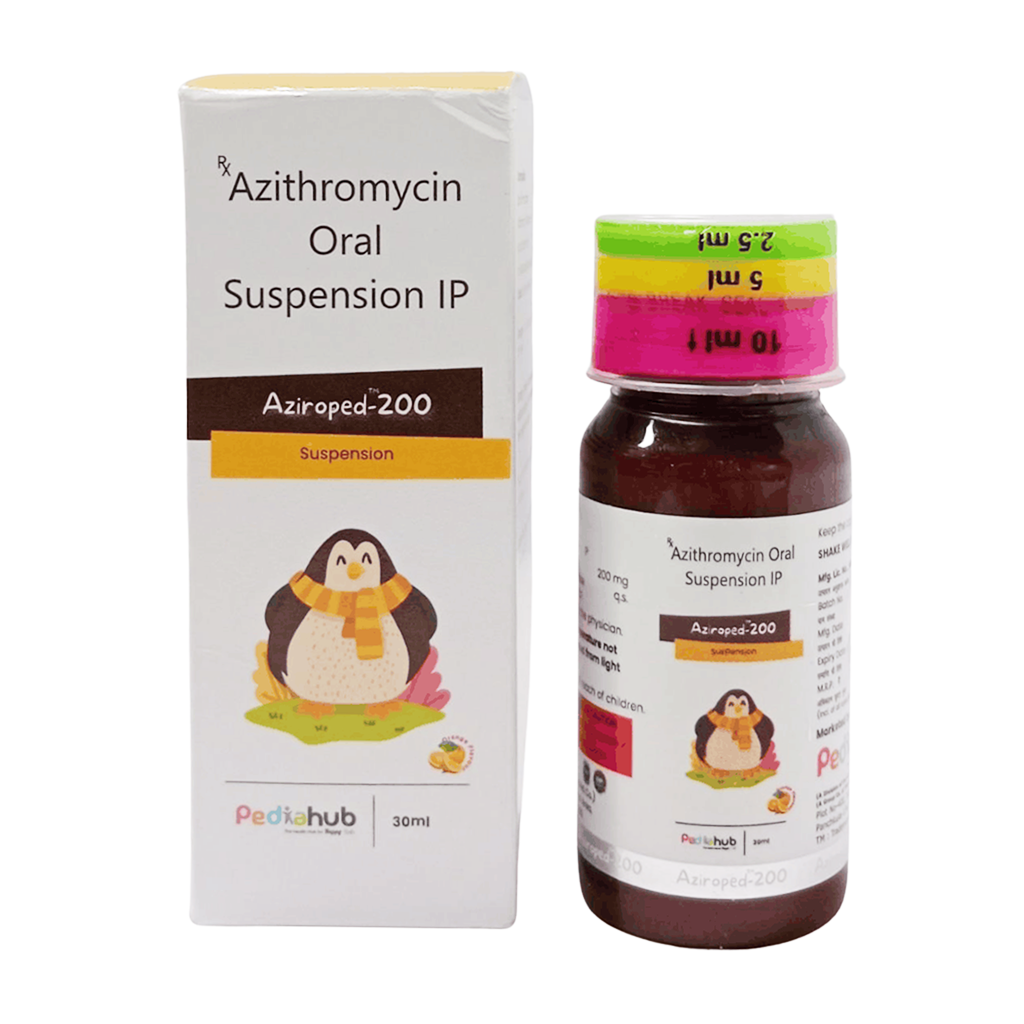
Aziroped 200 Susp Azithromycin Suspension 200mg Measuring cap, mono carton
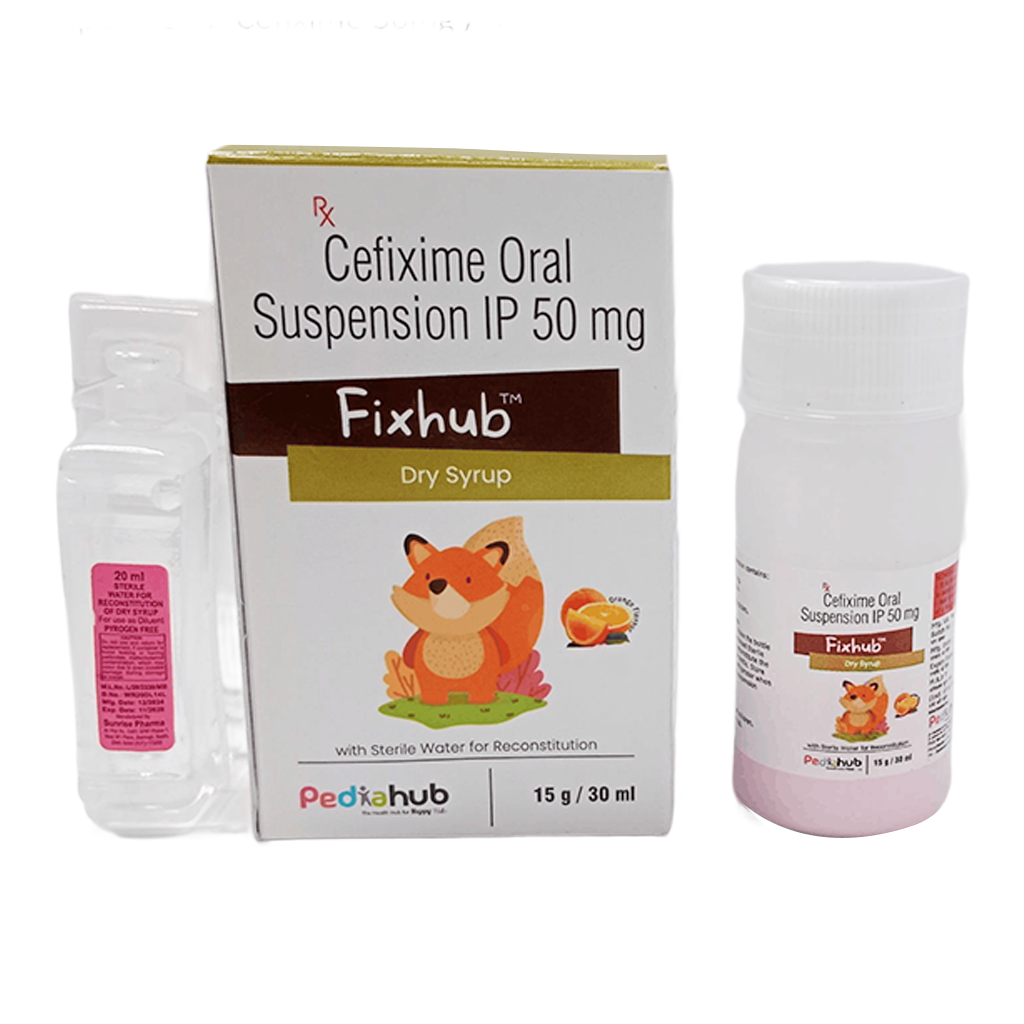
Fixhub Dry Syp Cefixime 50mg/5ml HDPE bottle with dist. H2O
Fixhub Forte Dry Syp Cefixime 100mg/5ml HDPE bottle with dist. H2O
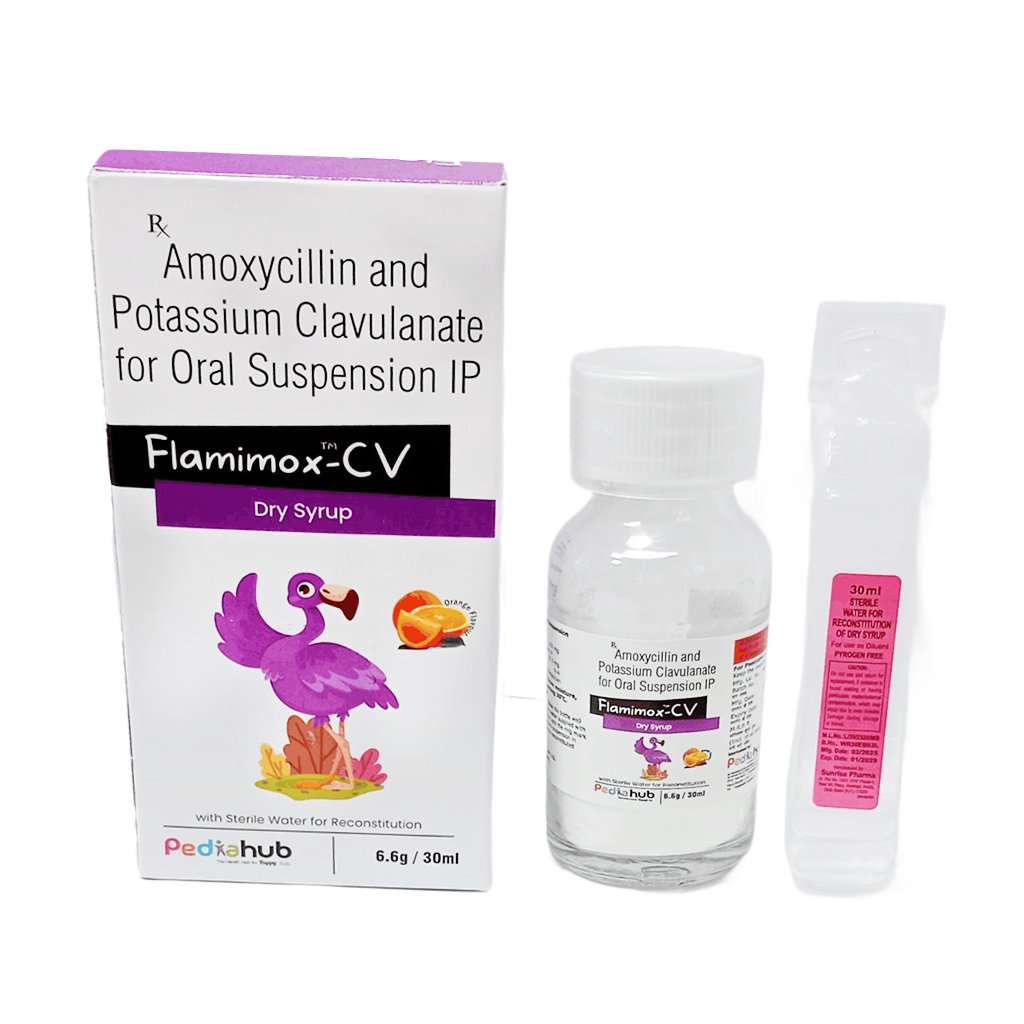
Flamimox CV Dry Syp Amoxicillin 200mg + Potassium Clavulanate 28.5mg/5ml Glass bottle with dist. H2O
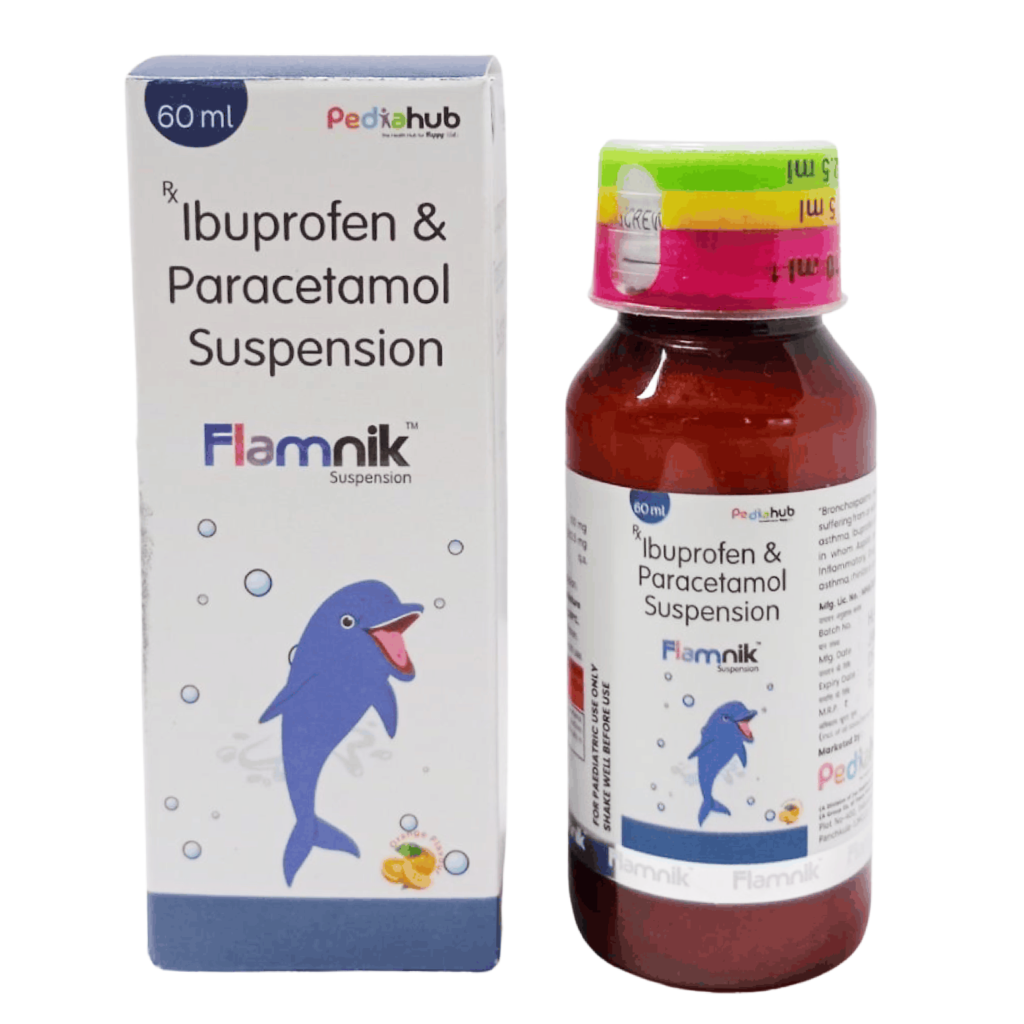
Flamnik Susp Ibuprofen 100mg + Paracetamol 162.5mg Measuring cap, mono carton
Flamcold DS Syp Phenylephrine 5mg + Chlorpheniramine 2mg + Paracetamol 250mg Measuring cap, mono carton
Guthub Bacillus Clausii 2 billion spores Outer carton
Granitod Granisetron 1mg Outer carton with dropper
Ipratime-L Levosalbutamol 0.63mg + Ipratropium 500mcg Respules
Cinophate Dry Syp Clarithromycin 125mg HDPE bottle with dist. H2O

This is just an overview of our full range, as we have more than 50 products in our catalogue. We keep expanding as new molecules and combinations enter the market. A pediatric healthcare franchise built on this kind of depth is highly preferred by doctors and healthcare facilities.  

Business Opportunity: What the Investment Looks Like 

One reason so many pharma professionals opt for this model is the entry cost. Running a Best Pediatric Range PCD Franchise doesn’t call for a factory, a large sales force, or years of runway before it turns a profit. Most of the money goes into opening stock and the first round of promotional material. 

Head Approximate Investment (INR)
Product stock (initial order) 50,000 – 1,50,000
Promotional inputs (visual aids, MR bags, samples) 15,000 – 30,000
Registration & documentation 5,000 – 10,000
Working capital buffer 25,000 – 50,000
Total starting range Roughly 1 – 2.5 lakh

A Case Study: Here’s How Our Jalandhar-Based Client Grows with Us 

We at Iva Healthcare let our franchise partner grow with us. And here is an example of our Jalandhar-based client. The client started with a focused list of 15–20 fast-moving products — the antibiotic suspensions, the cold and cough syrups, a probiotic, and a multivitamin.  

In the first quarter, most of the effort was put into visiting paediatric clinics and nursing homes with samples and visual aids. By the second or third quarter, repeat orders from five or six regular doctors typically started covering the monthly running cost. The partner started adding SKUs from our catalogue as demand from specific clinics became clear.  

However, this is just a general pattern. Actual results depend on the territory, competition, and the partner’s own groundwork. 

How to Choose the Right Pediatric Range PCD Company 

Check the product range first. 

A proper pediatric PCD company covers syrups, suspensions, drops, dry syrups, and sachets across the common categories: antibiotics, antipyretics, cough and cold, probiotics, and multivitamins. If a company only has 15-20 products and half of them overlap, you’ll struggle to build a full basket for a paediatrician. Ask for the complete product list before anything else. 

Look at manufacturing standards. 

WHO-GMP and ISO certification aren’t optional here. Ask which manufacturing units the company uses, and if possible, ask for the drug licence and manufacturing licence copies.  

Assess packaging and formulation quality. 

Kids’ medicines sell on taste, colour, and ease of dosing. Check if suspensions come with proper measuring caps, if bottles are child-resistant, and if flavours are actually palatable. Ask for samples and test them yourself before committing to a territory. 

Verify monopoly rights and territory terms. 

Most pediatric PCD companies offer monopoly distribution rights by district or state. Get this in writing, with a clear clause on what happens if the company appoints someone else in your area later. Also check the minimum order quantity. 

Ask about promotional support. 

Visual aids, MR bags, prescription pads, sample kits, and gifts matter more in paediatrics because trust with doctors builds slower. Find out exactly what the company provides free versus what you need to pay for. Some companies promise support on paper and deliver almost nothing once you’ve signed up. 

Check payment terms and pricing. 

Compare the PTR (price to retailer) and PTS (price to stockist) margins against at least two or three other paediatric PCD companies before deciding. Also check credit terms, since paediatric products often have shorter shelf lives, and a company that pushes long-dated stock near expiry will cost you later in returns. 

Talk to existing distributors

Before signing, get in touch with two or three of the company’s current franchise partners. Ask about delivery timelines, stock availability during peak season (monsoon and winter, when paediatric demand spikes), and how the company handles complaints or damaged stock. This one conversation tells you more than any brochure will. 

At Iva Healthcare, we tick all these boxes to become your best pediatric range PCD franchise in India.  

Getting Started 

If you’re ready to check product availability and investment figures for your district, get in touch with IVA Healthcare or call +91 8054932727. 

FAQs 

Q.1 What is a Pediatric PCD Pharma Franchise? 

Ans. It is a business model where a pharma company grants you the rights to market and sell its pediatric product range in a defined territory, under monopoly terms. You take care of sales and distribution in the locality; the company takes care of manufacturing, quality certification and promotional support.  

Q2. What is the investment required in a pediatric PCD franchise?  

Ans. Most partners start with an investment ranging from Rs. 1 lakh to Rs. 2.5 lakh, covering initial stock, promotional material and a working capital buffer. The exact figure depends on your state and how large a territory you want to hold. 

Q3. Is monopoly right guaranteed with every pediatric franchise company? 

Ans. Not always — it depends on the company. Genuine monopoly-basis franchises promise that no other distributor carrying the same brand will operate in your territory. Always get this in writing before you commit stock or money. 

Q4. What documents are needed to start a pediatric PCD franchise? 

Ans. Typically, a drug license, GST registration, a valid ID and proof of address are required. Some companies also require a declaration or agreement to be signed confirming the terms of monopoly and minimum order commitments.  

Q5. How long does it take to start getting returns from a pediatric franchise?  

Ans. Most partners start to receive steady repeat orders within two to three months, after a handful of regular doctors and clinics are on board. The growth thereafter depends largely on how regularly you are visiting clinics and how broad your product range is.  

Q6. Are pediatric medicines safe for a long-term franchise business?  

Ans. Yes pediatric prescriptions are driven by ongoing healthcare needs rather than trends, which is why the segment tends to hold up better than seasonal or lifestyle categories during slow periods. 

Written by the IVA Healthcare Team

We’re part of IVA Healthcare, a division of Theon Pharmaceuticals, based in Panchkula, Haryana. Over the years we’ve worked directly with 500+ franchise partners across India, and this piece pulls from what we’ve actually seen on the ground — setting up and growing pediatric PCD franchises through our Pedia Hub division.

Best Pediatric Drops PCD Pharma Company in India Complete 2026 Guide 

Best Pediatric Drops PCD Pharma Company in India: Complete 2026 Guide 

Quick Answer

A genuine pediatric drops PCD company like IVA Healthcare offers WHO-GMP/ISO-certified manufacturing, accurate dosing droppers, and written monopoly rights. Before signing up, check the product range, sample quality, minimum order quantity, and distributor support. Investment typically starts around ₹40,000–₹1.5 lakh, depending on the company and product portfolio.

Parents don’t compromise on medicine for their kids. That’s the first thing to understand for any new pediatric pharma franchise. 

A pediatric drops PCD pharma company that uses the right formulation, prices it fairly, and backs it with proper documentation is always preferred. If you are choosing a pediatric drops PCD franchise, this guide covers what actually matters.  

We have highlighted how to determine the quality of pediatric drop products as well as how to market your business. Also, you will get to know the latest market trends and investment numbers.  

We hope that you will be armed with essential info to work with any pediatric drops PCD pharma company. Let’s get started.  

What Makes a Good Pediatric Drops PCD Pharma Company? 

Many pharma companies have listed paediatric syrups in their catalogue. But that doesn’t mean all of them specialise in those syrups.  

A genuine Pediatric drops PCD pharma company will show you: 

  • A dedicated paediatric formulation range — multivitamin drops, iron drops, probiotic drops, colic relief drops, zinc drops 
  • Sugar-free and colour-free options, since paediatricians increasingly ask for these 
  • Proper stability data and shelf-life testing for liquid formulations, which behave very differently from tablets 
  • Child-resistant packaging with accurate dropper calibration. A dropper that’s off by even half a millilitre becomes a serious dosing problem in infants.  

You can also order some samples from your potential pediatric drops manufacturer for PCD Franchise.  A reliable company won’t hesitate to provide them. 

What Makes a Good Pediatric Drops PCD Pharma Company

Market Trends Impacting Pediatric Drops PCD Franchise in 2026 

India’s paediatric formulation market has been on the rise with increasing birth rates in Tier 2 and Tier 3 cities and better awareness of infant nutrition as key factors. Before choosing any PCD pharma franchise for pediatric drops, make sure the provider has products according to these latest market trends.  

1. Combination Drops Are Winning  

Vitamin D3 + Calcium, or multivitamin + zinc, sell better than single-nutrient drops because doctors prefer fewer bottles per prescription. 

2. The Rise Of Herbal Alternatives 

Ayurvedic and herbal drops are gaining traction, especially for immunity and digestion.  

3. Healthcare Awareness in Small Cities 

Tier 2/3 demand is growing faster than metros, where distribution based on monopoly works especially well.  

4. Packaging matters more.  

Tamper-proof seals and a clear dosage chart on the label are becoming non-negotiable.  

Market Trends Impacting Pediatric Drops PCD Franchise in 2026 

👶 Here Are Some of Our Pediatric Products

Comparison: What to Look for Across Companies  

This comparison table helps you differentiate between the right pediatric drops PCD company in India and an unverified one.   

Factor Established PCD Company New/Unverified Supplier
Certifications WHO-GMP, ISO, GLP-tested formulations Often just a trade licence
Product range 25–50+ SKUs across drops, syrups, suspensions Limited, generic range
Monopoly rights District or state-wise, in writing Verbal promises, no agreement
Packaging Calibrated droppers, tamper-proof seals Basic packaging, inconsistent quality
Marketing support Visual aids, MR bags, sample kits, product literature Minimal or none
Payment terms Transparent, staged for new partners Full advance demanded upfront

Use this as a checklist on your first call with any supplier. If they can’t answer two or three of these clearly, keep looking. 

Investment Guide for PCD Pharma Franchise for Pediatric Drops: What It Actually Costs 

Numbers vary by company and product portfolio, but here’s a realistic range for starting a pediatric drops PCD franchise in India: 

Item Details
Franchise/security deposit ₹15,000–₹50,000, refundable with most established companies
First order (minimum quantity) ₹25,000–₹75,000, depending on the product range
Marketing material and samples Often free or at nominal cost from the company
Working capital Budget roughly two months of running stock, since drops have a shorter shelf life than tablets

On the whole, the total starting investment typically falls between ₹40,000 and ₹1.5 lakh with a genuine pediatric drops PCD pharma company.  

That’s significantly lower than setting up your own manufacturing facility. That’s why the PCD model appeals to first-time pharma entrepreneurs and experienced medical reps.  

Investment Guide for PCD Pharma Franchise for Pediatric Drops

Marketing Strategies That Actually Work for a Pediatric Drops PCD Franchise 

Target High-Volume Pediatric Clinics and Neonatologists 

This is where you can find your target customers. After all, the core driver of your pediatric drops is direct doctor prescriptions. While pitching your products to them, make sure to highlight clinical safety, exact dropper precision, and pleasant flavours (such as non-bitter, natural fruit flavours) for children.  

Build a Paediatrician-First Network 

Building a network with pharmacists is equally important. This is where the promotional material supplied by your company, such as visual aid booklets, free samples, prescription pads, and PDF-based presentations, can help.  

Build an Online Presence 

Having a digital presence can also help, as many people (including doctors and pharmacists) search for services/products online. Make sure to have a Google Business listing and WhatsApp catalogue ready when doctors or chemists want to verify you before ordering. You can also work with an online pharma marketing professional for a serious growth strategy.  

Key Challenges and How to Overcome Them 

This segment comes with its share of challenges. One of them is stock expiry. Liquid formulations generally have 18-24 month shelf lives, shorter than tablets. So, over-ordering can be a complicated decision for you. Keeping a competitive price without cutting into your margin is another issue to deal with.  

Here is how you can address such issues.  

Business Challenge Potential Impact Recommended Solution
Strict Quality Control Batch rejections or brand damage Partner only with WHO-GMP & ISO-certified companies.
Palatability Issues Children refusing bitter medicine Source drops with child-approved natural flavours (Mango, Orange, Bubblegum).
Territory Overlap Price wars with other distributors Secure signed, written Monopoly Rights agreements for your district.
Supply Chain Delays Stockouts during peak seasonal illness Choose a Pediatric drops PCD pharma company with a nationwide dispatch network.
Shorter Shelf Life Risk Over-ordering causes expired inventory loss (liquid formulations have 18–24 month shelf lives vs. longer tablet lifespans) You can opt for smaller orders more often, based on your monthly sales.
Competitive Pricing vs. Margin Squeeze Price pressure from competing brands eats into net profits Work with companies offering genuine prices. Also, highlight the high quality of formulation to justify the cost.

Future Outlook 

Many parents choose specialised paediatric formulations. They prefer simple solutions such as pediatric formulations over hard-to-swallow adult tablets. Working with a good pediatric drops PCD pharma company can lead to a sustainable, scalable business.  

The Conclusion 

Picking the right pediatric drops PCD pharma company comes down to three things: verified certifications, honest monopoly agreements, and a product range actually built for infants, not repackaged adult formulations. Check the comparison points above before you commit, and you’ll save yourself trouble down the line. 

 FAQs 

Q1. What is the investment needed for opening a Pediatric Drops PCD Franchise? 

Ans. Most franchises start between ₹40,000 and ₹1.5 lakh, which includes security deposit and first order. 

Q2. What certifications should a Pediatric Drops PCD Company in India have? 

Ans. Look for minimum certifications like WHO-GMP, ISO and GLP-tested formulations. Ask for real certificates and not just a mention on the website. 

Q3. Are the distribution rights for pediatric drops monopoly-based? 

Ans. Yes, most established companies offer district- or state-wise monopoly rights. Get this confirmed in a written agreement. 

Q4. What are the standard products in a pediatric drops range?  

Ans. Most companies have the same core products, and they are multivitamin drops, iron drops, vitamin D3 drops, zinc drops, probiotic drops, and colic relief drops.  

Q5. What to do if bitter formulations are not accepted by doctors due to the taste issues in children? 

Ans. In this case, you can opt for child-approved natural flavours such as mango, orange and bubblegum.  

📞 Contact Us

Text or call us for more details regarding Pediatric Products and Pediatric PCD Pharma Franchise in India, or for any other related queries.

Company Name: IVA Healthcare
Address: 403, Industrial Area, Phase-1, Panchkula, Haryana – 134113
Phone: +91-8054932727, 0172-5210100, 128
Website: www.ivahealthcare.com